


What Should You Pay Attention to When Exchanging Currency Abroad?
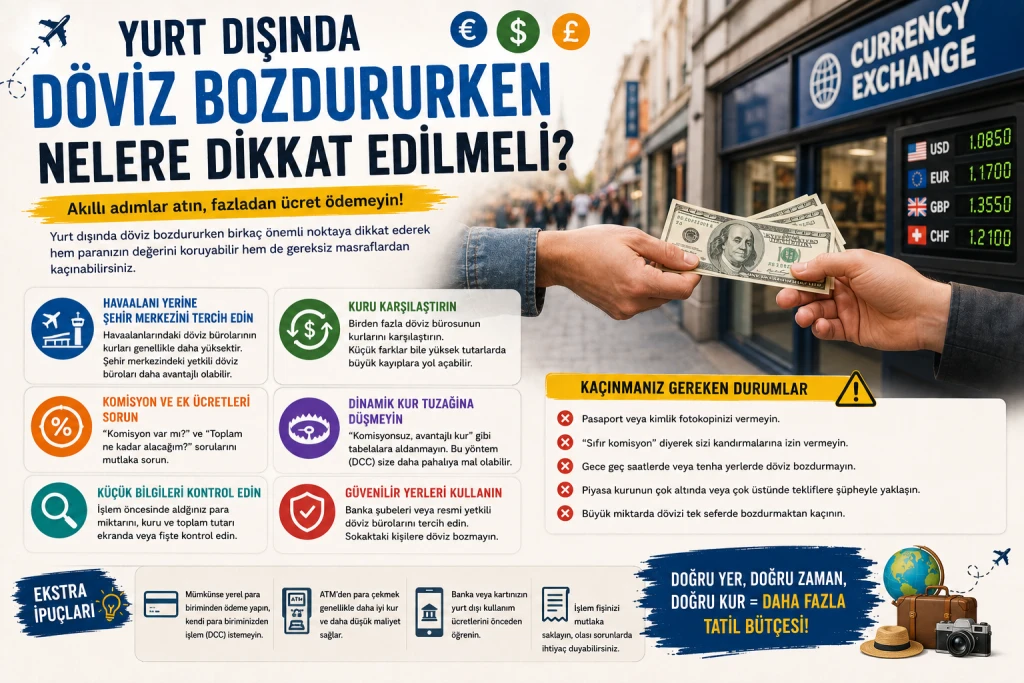
What Should You Pay Attention to When Exchanging Currency Abroad? Protect Yourself from Exchange Rate Differences and Unnecessary Costs
When going on a vacation abroad, planning your money management correctly is just as important as making your flight and hotel reservations. Especially when exchanging currency, choosing the wrong place, high commissions, or unfavorable exchange rates can cause your travel budget to decrease unnecessarily.
So, where should you exchange currency abroad? Is it sensible to exchange money at the airport? Is it more advantageous to use an ATM or visit a currency exchange office? What should you pay attention to when paying by card?
In this guide, you can find important points to consider when exchanging currency abroad and practical ways to protect your travel budget.
Why Is Exchanging Currency Abroad Important?
When you need cash during your trip, you may need to convert your Turkish lira or another currency into the local currency.
However, not every currency exchange office or ATM applies the same rate.
For example, on the same day:
- One currency exchange office may offer a lower rate.
- Another business may charge a high commission.
- An ATM may apply an additional transaction fee.
- Your bank may charge an international cash withdrawal fee.
Therefore, you should consider not only “How much will I receive?” but also “How much will I actually have left after the transaction?”
1. Think Before Exchanging Currency at the Airport
Airports are among the easiest places to access for exchanging currency. However, being easily accessible does not always mean that the most advantageous rate is available there.
At airport currency exchange offices, there may be costs such as:
- Exchange rate differences
- Commission
- Transaction fee
Therefore, if possible, consider keeping only the amount necessary for your initial transportation and urgent needs at the airport, and comparing larger currency exchanges with reliable options in the city center.
2. Do Not Rely Solely on the Phrase “No Commission”
Some currency exchange offices may advertise “no commission.”
However, not charging a commission does not necessarily mean that the transaction is advantageous.
The business may profit from the difference between the buying and selling rates.
Therefore, the following should be evaluated together:
Exchange Rate + Commission + Transaction Fee
3. Do Not Confuse the Buying and Selling Rates
There are generally two different rates at currency exchange offices:
Buying rate: The rate at which the business buys foreign currency from you.
Selling rate: The rate at which the business sells foreign currency to you.
If you are converting the foreign currency you have into the local currency, the rate that matters to you is the buying rate.
Knowing this distinction can prevent you from making incorrect calculations.
4. Ask for the Net Amount Before Making the Transaction
Before exchanging currency, ask the following question instead of only asking about the rate:
“How much will I receive net for this amount of foreign currency?”
For example, if you are exchanging €500, find out how many units of the local currency you will receive at the end of the transaction.
This way, you can see the actual result, including the exchange rate and commission.
5. Compare Multiple Currency Exchange Offices
If possible, compare several different locations instead of making a transaction at the first currency exchange office you see.
There may be differences between currency exchange offices, especially in tourist areas.
When comparing, look at details such as:
- Buying rate
- Selling rate
- Commission
- Transaction fee
- Net amount you will receive
Even a 5-minute comparison can make a difference to your travel budget.
6. Be More Careful in Tourist Areas
There may be many currency exchange offices in city centers and tourist areas.
However, do not make your decision based only on the large exchange rate displayed on the sign.
Before the transaction, ask questions such as:
- Is there a commission?
- Which transaction does the rate apply to?
- Are there any additional fees?
- Will a receipt be provided?
7. Count Your Money After the Transaction
After completing the currency exchange, check your money before leaving the business.
Especially for high-value transactions, check:
- The amount of money
- The banknotes
- The receipt
- The transaction amount
If you notice a problem, it may be easier to resolve it while you are still at the location where you made the transaction.
8. Keep the Receipt or Transaction Document
It may be useful to keep the receipt or transaction document provided when you exchange currency.
This document can help you check:
- The transaction amount
- The applied exchange rate
- The commission
It can also be used as a transaction record if any dispute arises.
9. Be Careful When Using ATMs
Using an ATM abroad can be very practical. However, you may also encounter certain fees.
For example, the following may apply:
- ATM usage fee
- Bank transaction fee
- Currency conversion fee
- Exchange rate difference
Therefore, carefully review the fees shown on the ATM screen before completing the transaction.
10. Make Sure the ATM Belongs to a Bank
Whenever possible, it may be safer to choose ATMs belonging to well-known banks or reliable financial institutions instead of random ATMs.
Transaction fees and conversion conditions may differ at independent ATMs, especially in tourist areas.
Check the ATM owner and transaction fees.
11. Be Careful If the ATM Offers Currency Conversion
At some ATMs, while withdrawing money, you may be offered the option to complete the transaction using:
The local currency
or
Your card’s currency
At this point, it is important to carefully review the conversion rate offered by the ATM and the total cost.
In general, before making a decision, check how much you will pay in fees with each option.
12. Learn About Your Bank’s International Transaction Fees
Before traveling, check your bank’s:
- International POS usage fees
- ATM cash withdrawal fees
- Currency conversion rates
- Daily cash withdrawal limit
Learning this information in advance can reduce the likelihood of encountering unexpected expenses during your trip.
13. Do Not Pay for Everything in Cash
It is useful to have some local currency with you when traveling abroad.
However, carrying your entire travel budget in cash is not always a good idea.
Where possible, you can use:
- Cards
- Mobile payments
- Reliable payment applications
This reduces the need to carry large amounts of cash.
14. Keep Small Amounts of Local Currency with You
Cash may be needed for taxis, small businesses, markets, or certain transportation points.
Therefore, it may be useful to carry enough local currency for your needs on the first day of your trip.
For example, you can set aside enough cash for:
Airport → Hotel → First meal → Small expenses
15. Do Not Assume You Can Easily Exchange Turkish Lira in Every Country
In some countries, demand for Turkish lira may be low.
Therefore, a direct:
TRY → Local Currency
conversion may not be advantageous everywhere.
It is useful to research in advance which currencies can be easily exchanged at your destination.
16. Traveling with Euros or Dollars Is Not Always More Advantageous
Some people prefer to buy euros or dollars instead of Turkish lira when traveling abroad.
This may be practical in some destinations. However, you should also consider the cost of two separate currency conversions.
For example, carrying out two transactions in the form of:
TRY → Euro → Local Currency
may create additional costs due to exchange rate differences.
Therefore, research the currency of the country you will visit and the current conversion conditions in advance.
17. Do Not Carry Too Much Cash
Carrying large amounts of cash during travel can pose a serious risk if it is lost or stolen.
Therefore:
- Carry only as much cash as you need for the day.
- Do not keep all your money in the same place.
- Distribute your funds reasonably between cards and cash.
- Keep your passport and money safe.
It may be safer not to rely on a single payment method for your travel budget.
18. Track Exchange Rates Before Your Trip
Following the foreign exchange market a few days or weeks before your trip can help you plan your budget more accurately.
In particular, you can calculate your international vacation budget as:
Accommodation + Transportation + Food and Drink + Activities + Shopping
in the local currency to estimate the approximate total cost.
19. Check the Reliability of the Currency Exchange Location
Make sure that the business where you will exchange currency is reliable.
In particular, choose:
- Official businesses
- Well-known banks
- Reliable currency exchange offices
Be cautious of excessively high or unrealistic exchange rate offers.
If you see an offer that differs greatly from normal market conditions, be sure to ask about the terms before making the transaction.
20. Set Your Travel Budget in Advance
Knowing how much money you need when exchanging currency can prevent unnecessary transactions.
For example, you can divide your daily budget into categories such as:
- €50 accommodation
- €30 food
- €15 transportation
- €20 activities
These figures will vary depending on the destination, but creating a budget in advance makes it easier to control your spending.
Should You Exchange Currency Abroad or Use a Card?
There is no single correct answer to this question.
The ideal method is generally to use cash and a card together.
Advantages of using cash
- It can be used at small businesses.
- It may be practical for public transportation or small purchases.
- It is useful in places that do not accept cards.
Advantages of using a card
- It prevents you from carrying too much cash.
- It makes large payments easier.
- It can make it easier to track your expenses.
The best option may vary depending on the payment habits of the country you are visiting and your bank’s fees.
Contact Your Bank Before Traveling Abroad
Before your trip, check your bank’s current international usage conditions.
In particular, get information about:
- Whether your card is enabled for international use
- Daily limit
- ATM withdrawal limit
- Currency conversion conditions
- International transaction fees
It may also be useful to have an alternative payment method that you can use in an emergency.
The Most Common Mistakes When Exchanging Currency
Try to avoid the following mistakes while traveling:
❌ Exchanging all your money at the airport
❌ Looking only at the “no commission” sign
❌ Confusing the buying and selling rates
❌ Failing to check ATM fees
❌ Not counting your money after the transaction
❌ Not taking the receipt
❌ Carrying too much cash
❌ Using unreliable currency exchange offices
❌ Using your card without knowing its international fees
❌ Relying on a single payment method for your entire budget
Practical Checklist for Exchanging Currency Abroad
Check this list before your trip:
☐ I have learned the currency of the country I am visiting.
☐ I have checked the current exchange rate.
☐ I have learned my bank’s international fees.
☐ I know the ATM usage fees.
☐ I have enough local currency for the first day.
☐ I have researched reliable currency exchange offices.
☐ I have checked whether my card can be used abroad.
☐ I have an alternative payment method for emergencies.
☐ I am not carrying a large amount of cash.
☐ I keep my receipt for currency transactions.
How Can You Protect Your Travel Budget Against Exchange Rate Fluctuations?
Calculate your vacation budget not only in Turkish lira but, if possible, also in the currency of the country you will visit.
For example, for a 5-day trip, you can estimate the costs of:
Accommodation + Transportation + Food and Drink + Activities + Shopping
in the local currency.
Then add a small contingency allowance on top.
This method can help you control your budget more easily during your trip.
The Most Important Rule When Exchanging Currency
When exchanging currency abroad, do not look only at “What is the exchange rate?”
The real question should be:
“How much money will I actually receive after all fees are deducted?”
You can see the actual cost by evaluating the exchange rate difference, commission, ATM fee, and bank charge together.
Plan Your Vacation More Intelligently
As with currency transactions, planning other vacation expenses in advance can help protect your budget.
By comparing flights, hotels, transfers, and activities before your trip, you can reduce unexpected expenses you may encounter during your vacation.
Especially when traveling abroad, planning major expenses such as accommodation and transportation in advance can help you better manage the impact of exchange rate changes on your budget.
Choose your destination, compare flight and hotel options, and make your reservation by planning your budget-friendly vacation abroad now!