


Ways to Save Money While on Vacation
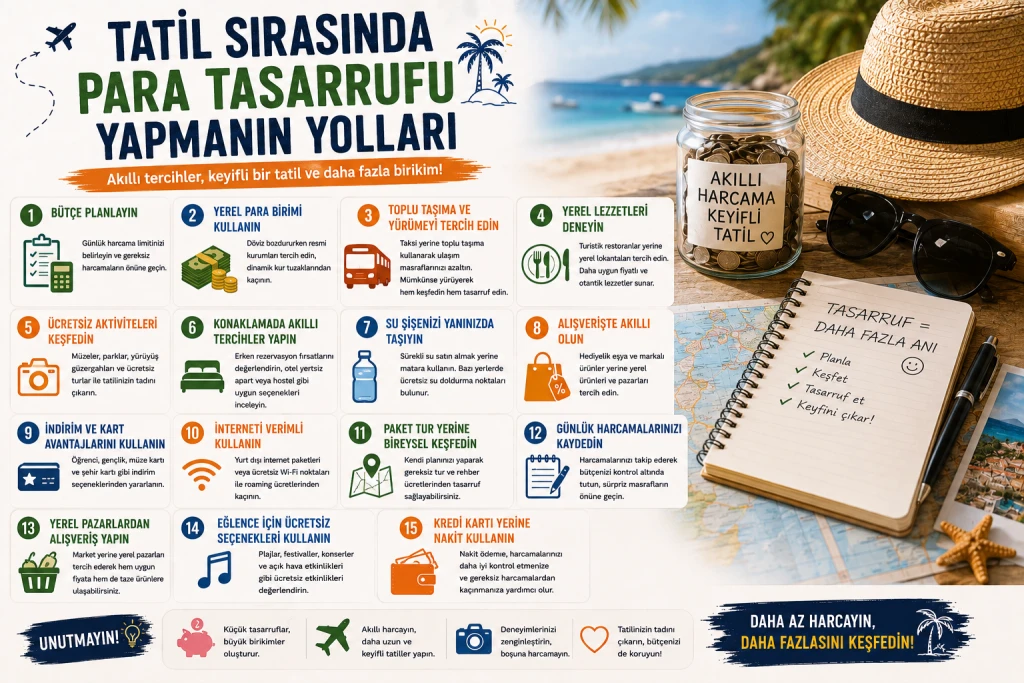
Ways to Save Money During Your Vacation: 20 Effective Tips to Protect Your Budget
Keeping your vacation budget under control is just as important as going on vacation. Food and drink, transportation, activities, and shopping expenses that begin after your flight and hotel reservations are completed can cause you to exceed your vacation budget without realizing it.
However, with a few simple methods, you can reduce unnecessary expenses during your vacation, travel more and enjoy a pleasant vacation for longer with the same budget.
So how can you save money on vacation? How can daily expenses be controlled? What should you pay attention to when spending money abroad?
Here are 20 practical ways to save money that will help you protect your vacation budget!
1. Set a Daily Spending Limit Before Going on Vacation
The first step to saving money during your vacation is to set a daily budget.
For example, if the total amount you can spend for a 5-day vacation is TRY 15,000:
15,000 ÷ 5 = TRY 3,000
can be your average daily spending limit.
You can divide this budget into categories such as;
- Food and drink
- Transportation
- Activities
- Shopping
2. Divide Your Vacation Budget by Day
Make a daily plan instead of considering the total budget all at once.
For example:
Morning: Breakfast
Noon: Affordable restaurant
Afternoon: Free activity
Evening: Planned restaurant
Transportation: Public transportation
This method makes it easier to track how much you can spend during the day.
3. Compare Prices in Tourist Areas
Prices in vacation destinations can vary even within a few streets.
In particular, compare the prices of:
- Restaurants
- Cafés
- Souvenirs
- Markets
- Taxis
You can research options in slightly more local areas instead of businesses in main squares and the most touristy areas.
4. Choose Local Restaurants
Eating every meal at tourist restaurants during your vacation can quickly increase your budget.
Restaurants preferred by local people may offer more affordable options in most destinations.
In addition, choosing local restaurants is a great opportunity to discover the destination’s authentic culinary culture.
Spend less and discover more authentic flavors.
5. Take Advantage of Grocery Shopping
Markets can provide significant savings, especially during longer vacations.
Buying water, fruit, breakfast foods, and snacks from a market may be more economical than paying prices at restaurants and tourist attractions.
If you have chosen accommodation with a kitchen, you can reduce your budget even further by preparing some meals yourself.
6. Pay Attention to Coffee and Snack Expenses
Expenses that seem small during a vacation can have a significant impact on your total budget.
For example, control expenses such as:
- Daily coffee
- Ice cream
- Dessert
- Water
- Snacks
Instead of making several small purchases every day, include them in the daily budget you set in advance.
7. Use Public Transportation
Taxis, especially abroad, can make up a significant portion of your vacation budget.
Whenever possible, use public transportation options such as:
- Metro
- Tram
- Bus
- Train
- Ferry
Some cities may offer daily or weekly transportation cards. It may be useful to research these before your vacation.
8. Plan Places You Can Explore on Foot
You do not have to travel everywhere by vehicle.
You can explore nearby:
- Historic areas
- Museums
- Bazaars
- Squares
- Parks
on foot within the same day.
This method both reduces transportation costs and allows you to get to know the city more closely.
9. Research Free Activities
Not every activity needs to be paid for in order to have fun during your vacation.
Depending on the destination, consider:
- Beaches
- Parks
- Viewpoints
- Historic streets
- Local markets
- City walks
- Free events
You can save your budget for paid and special experiences.
10. Check Museum Passes and City Cards
If you are going to visit multiple museums or tourist attractions in a city, city cards or combined admission tickets may offer an advantage.
Compare the total cost instead of buying tickets individually.
However, before purchasing a card, check whether the places you will actually use are included.
11. Plan Activity Tickets in Advance
Activities purchased after making a last-minute decision during your vacation may sometimes be more expensive.
Research the prices of the following in advance:
- Museums
- Boat tours
- City tours
- Theme parks
- Concerts
- Guided tours
This allows you to determine your budget in advance and avoid last-minute price increases.
12. Plan Your Airport Transfer in Advance
Unplanned taxi rides on the first and last days of your vacation can increase your budget.
Compare the following airport transfer options:
- Public transportation
- Airport bus
- Train
- Shared transfer
- Private transfer reserved in advance
Keep your budget under control from the very first minute of your vacation.
13. Be Careful When Exchanging Currency
It is important to be careful with currency transactions when traveling abroad.
Exchange offices at airports and in highly touristic areas may have unfavorable exchange-rate differences.
Before exchanging money:
- Check the current exchange rate.
- Ask whether there is a commission.
- Consider the option of paying by card.
- Review transaction fees.
This way, you can avoid unnecessary exchange-rate differences.
14. Pay Attention to the Currency Selection When Paying by Card
When paying by card abroad, some terminals may offer you the option to pay in your card’s currency instead of the local currency.
Check the exchange rate and additional fees on the payment screen.
Especially if dynamic currency conversion (DCC) is offered, evaluate which option is more advantageous according to your bank’s current terms.
15. Avoid Unnecessary Shopping
It is easy to shop impulsively in stores or souvenir shops during your vacation.
Set a shopping budget for yourself before going on vacation.
For example:
Shopping budget: TRY 3,000
Try not to exceed this limit.
16. Compare Prices When Buying Souvenirs
The same product may be sold at different prices in different stores.
Compare several stores when buying items such as:
- Magnets
- Textile products
- Local foods
- Handmade products
- Souvenirs
Look at alternatives instead of immediately buying the first product you see.
17. Take Advantage of Free Services Offered by Your Hotel
Be sure to find out which services are included in your accommodation fee.
For example, services such as:
- Breakfast
- Wi-Fi
- Gym
- Pool
- Beach services
- Transfer
- Bicycle
- Daily activities
may be available.
Taking advantage of services you have already paid for can reduce additional expenses outside the hotel.
18. Track Your Expenses Throughout Your Trip
Note your daily expenses to prevent your budget from getting out of control during your vacation.
Every evening, ask yourself:
How much did I spend today?
For example:
Food and drink: TRY 800
Transportation: TRY 300
Activity: TRY 500
Shopping: TRY 200
Total: TRY 1,800
If your daily limit is TRY 2,000, you can see that you have kept your budget under control.
19. Do Not Touch Your Emergency Budget
Do not spend the entire budget you have set aside for your vacation.
Set aside a predetermined amount as an emergency budget.
This budget can be used for situations such as:
- Unexpected transportation
- Medical expenses
- Baggage problems
- Additional accommodation
- Changes of plans
20. Do Not Try to Make Everything Cheap
Saving money does not mean choosing the cheapest option in every aspect of your vacation.
For example, it may be more appropriate to set aside a budget for:
Safe transportation + clean accommodation + quality food + an unforgettable activity
The goal is:
Not to spend the least amount of money, but to use your money in the best possible way.
5 Areas That Save You the Most Money on Vacation
If you want to quickly bring your budget under control, focus on these areas first:
1. Food and Drink
Local restaurants and grocery shopping.
2. Transportation
Public transportation and walking.
3. Activities
Free events and combined tickets.
4. Shopping
A budget determined in advance.
5. Daily Spending
A maximum spending limit for each day.
Controlling these five areas can prevent your budget from being significantly exceeded by the end of your vacation.
What Not to Do When Saving Money on Vacation
Avoid these mistakes while trying to save money:
❌ Choosing unreliable accommodation
❌ Compromising on safety
❌ Evaluating travel insurance solely based on price
❌ Choosing a hotel that is too far away and difficult to reach
❌ Setting a food budget so low that you go hungry
❌ Spending your entire budget in the first days of your vacation
❌ Using your emergency budget
The purpose of saving is not to reduce the quality of your vacation, but to reduce unnecessary expenses.
The Difference Between Saving Before and During Your Vacation
A vacation budget is actually managed in two stages.
Before the Vacation
- Early booking
- Comparing flight tickets
- Choosing a hotel
- Planning transfers
- Researching activities
During the Vacation
- Daily budget
- Local restaurants
- Public transportation
- Free activities
- Controlled shopping
When you plan these two stages together, you can enjoy a higher-quality vacation with the same budget.
Spend Less, Enjoy Your Vacation More
Saving money during your vacation does not mean giving up on travel. On the contrary, with proper planning, you can allocate your budget to the experiences you truly value.
Set your daily spending limit, control your transportation and food and drink expenses, take advantage of free activities, and determine your shopping budget in advance.
Most importantly, clarify the total cost before going on vacation by comparing flight, hotel, transfer, and tour options.
Set your vacation budget now, compare destinations and accommodation options that suit you, and start planning your reservation for the trip of your dreams!