


Guide to Traveling Economically While Avoiding Tourist Traps
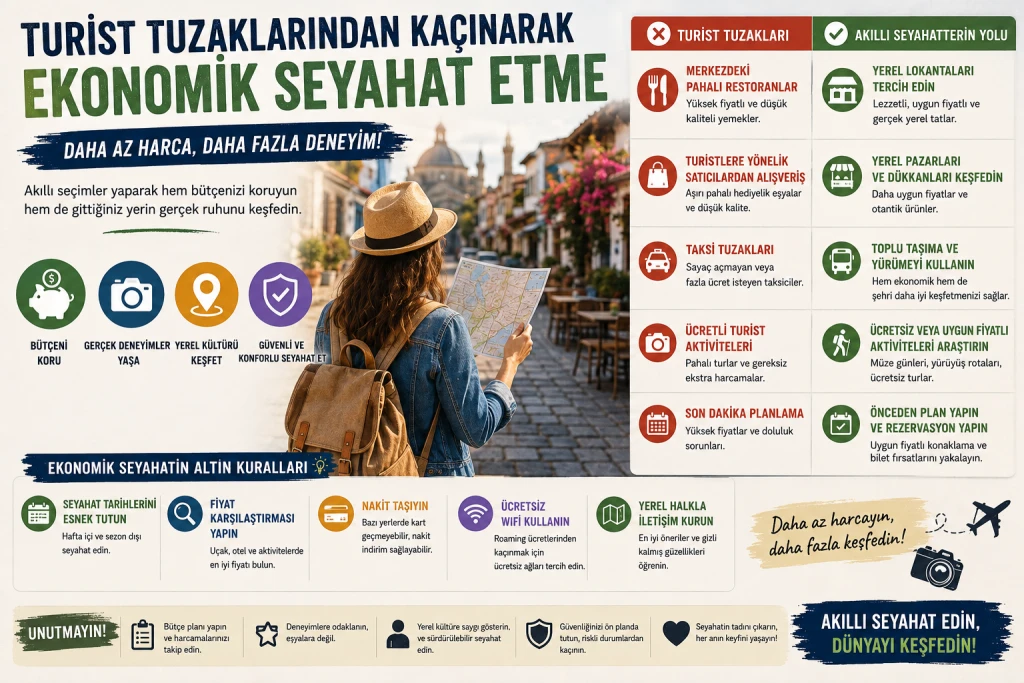
A Guide to Traveling Economically by Avoiding Tourist Traps: Explore More by Spending Less
Visiting a city for the first time is exciting. However, especially in popular tourist destinations, high prices, unnecessary services, expensive restaurants, and tourist-specific fees can consume your vacation budget much faster than expected.
The good news is this: With a few simple methods, you can avoid tourist traps, protect your travel budget, and explore the same destination much more affordably.
So what is a tourist trap, how can you avoid tourist traps, how can you travel abroad cheaply, and how can you plan a budget-friendly vacation?
Here is a comprehensive guide for those who want to travel more consciously, economically, and enjoyably!
What Is a Tourist Trap?
A tourist trap is a service, business, or practice that stands out for the purpose of charging visitors high fees or causing them to make unnecessary expenditures.
These do not always mean scams. Sometimes they may be completely legitimate businesses; however, they may offer the same service at a much higher price than what local people pay.
The most common tourist traps include:
- Overpriced restaurants in tourist areas
- Excessively high taxi fares
- Guides demanding additional fees
- Expensive souvenir shops
- Unnecessary tour packages
- High-priced services at the airport
- High commissions at currency exchange offices
- Additional fees that appear later
among others.
1. Compare Prices Before Making a Reservation
One of the most important rules of economical travel is not accepting the first price you see.
Compare different options before booking flights, hotels, transfers, or tours.
In particular, evaluate the total cost of:
Flight + Hotel + Transfer + Baggage + Taxes
at once.
An option that initially appears cheap may become more expensive when additional fees are added.
Therefore, look not only at the starting price but also at the total amount you will pay.
2. Be Careful When Choosing Restaurants in Tourist Areas
A restaurant located in a destination’s most famous square or directly at the entrance to its historic center may not always be the best option.
Prices may also be higher in tourist areas because rent and operating costs are high.
When choosing a restaurant:
- Check recent reviews.
- Check menu prices in advance.
- Ask about the service charge.
- Compare portion prices.
- Research places preferred by local residents.
Walking just a few streets away from the main tourist area can help you find more affordable options.
3. Be Careful with “Tourist Menu” Offers
Some restaurants in popular tourist areas may offer special tourist menus.
These menus are not always bad. However, it is important not to order without comparing their price and contents.
Check details such as:
- Price per person
- Whether drinks are included
- Service charge
- Taxes
- Charges for additional items
on the menu.
4. Avoid Unnecessary Spending at the Airport
In many destinations, airports may be more expensive than city centers.
It is useful to research prices in advance for services such as:
- Water
- Food
- Coffee
- Taxi
- Currency exchange
- SIM cards
- Transfers
in particular.
To reach the city, you can compare public transportation, official airport transfers, or private transfers reserved in advance.
5. Choose Official Services When Using Taxis
Taking a taxi in an unfamiliar city abroad can sometimes be stressful.
Especially at airports and tourist centers:
- Use official taxi stands.
- Check the taxi fare.
- If possible, view the price in advance through an app.
- Ask for the estimated fare before the journey.
- Avoid unofficial vehicles.
This way, you can reduce the risk of paying more than necessary.
6. Be Careful About Commissions When Exchanging Currency
When planning economical travel, do not focus only on hotel and flight prices.
Currency exchange transactions can also affect your travel budget.
Compare the exchange rates and commissions of currency exchange offices, especially those located at airports or in highly central tourist areas.
Also, when withdrawing money from an ATM, check the fees charged by your bank and the ATM operator.
7. Do Not Shop at the First Store When Buying Souvenirs
Souvenir prices can vary considerably in tourist areas.
The same product may be sold at different prices, such as:
€20 in the tourist square → €12 a few streets away
Compare several shops before making a purchase.
Especially in destinations where bargaining is common, it may be useful to research a reasonable price instead of accepting the first price quoted.
8. Do Not Pay for Places You Can Visit for Free
Many cities have numerous places that can be visited free of charge.
For example:
- Historic streets
- Squares
- Parks
- Viewpoints
- Free days at certain museums
- Local markets
- Beaches
can help you add free or low-cost activities to your travel itinerary.
Economical travel does not mean doing nothing; it means spending your money on the right experiences.
9. Research City Cards
Some cities may offer city cards for tourists.
In some cases, these cards may provide advantages such as:
- Public transportation
- Museum admissions
- Tourist attractions
- City tours
- Discounts
However, not every city card is economical.
Before purchasing a card, calculate the total price of the services you will use.
Do not buy a city card without calculating whether it will actually save you money.
10. Learn to Use Public Transportation
If you want to travel economically, learning the public transportation system provides a major advantage.
Research metro, tram, bus, and train options.
Especially when traveling from the airport to the city center, using public transportation can provide significant savings compared with taking a taxi.
However, take safety and comfort into account when traveling late at night or carrying a lot of luggage.
11. Do Not Look Only at the Room Price When Choosing Accommodation
Choosing an economical hotel is not simply a matter of comparing nightly prices.
For example, a cheap hotel located far outside the city center may become more expensive because of:
Cheap room + high transportation costs + lost time
Therefore, when choosing a hotel, evaluate details such as:
- Distance from the city center
- Public transportation
- Breakfast
- Taxes
- Parking
- Transfer
- Cancellation policies
together.
12. Check the Meaning of “Close to the Center”
The phrase “close to the center” in hotel descriptions can have a very broad meaning.
Check the hotel’s location on a map before making a reservation.
Look for answers to these questions:
- Where is the nearest metro station?
- Can you walk to the tourist areas?
- How much does transportation from the airport cost?
- Is it close to restaurants and markets?
This way, you can calculate not only the hotel price but also the transportation costs that will arise throughout your vacation.
13. Check Services Such as Free Breakfast and Wi-Fi
Even if two hotels appear to have the same price, the services they offer may differ.
For example:
Hotel A: €100 + €15 for breakfast
Hotel B: €110 + free breakfast
In this case, the second option may be more advantageous in terms of total cost.
Therefore, compare the included services when making a reservation.
14. Compare Tour Packages
Not every tour package has the same contents.
Before purchasing a tour, check whether services such as:
- Transportation
- Guide
- Museum admissions
- Meals
- Transfer
- Insurance
- Additional activities
are included.
“What is included in the price?” is one of the most important questions for economical travel.
15. Research Free City Tours
Some destinations may offer walking-based city tours or free city exploration events.
However, check the scope of the term “free.”
Some organizations may have a non-mandatory but expected tipping practice for guide services.
Therefore, it is useful to review the tour conditions in advance.
16. Keep Your Travel Dates Flexible
One of the most effective ways to travel economically is to keep your travel dates flexible.
In the same destination, there may be:
Weekend → higher prices
Weekdays → more affordable prices
Similarly, choosing off-season periods instead of peak season may help you find more affordable prices for:
- Flights
- Hotels
- Tours
- Car rentals
and more.
17. Travel Outside the Tourist Season
Off-season vacations can be highly advantageous for economical travel.
For example:
- Spring
- Autumn
- Suitable periods during the winter season
may offer more affordable accommodation options in some destinations.
In addition, reduced crowds in tourist areas can provide a more comfortable travel experience.
18. Explore Local Markets
You do not always have to choose businesses in tourist areas for food and shopping.
Local markets may offer great alternatives in terms of:
- More affordable food
- Local products
- Street food
- Souvenirs
- Cultural experiences
However, it is important to pay attention to hygiene conditions and local food safety practices.
19. Check Menu Prices in Advance
Look at the menu prices before sitting down at a restaurant.
Especially in tourist areas, having the menu available at the restaurant entrance or on its website can make budget planning easier.
To avoid surprises when the bill arrives, consider the total of:
Food + drinks + service + tax
in advance.
20. Be Cautious About “Very Cheap” Offers
Traveling economically is not the same as chasing excessively cheap offers.
Carefully review the terms of unrealistically cheap:
- Hotels
- Tours
- Transfers
- Car rentals
- Activities
offers.
Before making a reservation, check the business’s reliability, reviews, and cancellation policies.
A cheap price can become expensive when it results in a bad experience.
7 Signs of a Tourist Trap
If a business or service has several of the following characteristics, it may be useful to be more cautious:
- Prices are not clearly stated
- You are constantly being rushed
- There is pressure to act “today only”
- Menu or service details are not shown
- Additional fees are mentioned later
- There are very few or suspicious reviews online
- There is an excessive price difference compared with local alternatives
One of these signs alone does not mean that the business is unreliable. However, checking the price and service details before making a decision is the right approach.
How to Set a Daily Budget for Economical Travel?
You can create an approximate daily budget before your trip.
For example:
Accommodation + Transportation + Breakfast + Lunch + Dinner + Activities + Extra Expenses
Prepare a plan in this format.
Then add a small allowance for unexpected expenses to your total budget.
This method will help you keep your budget under control during your vacation.
Economical Travel Checklist Before Making a Reservation
Check the following items before completing your reservation:
☐ Is baggage included in the flight ticket?
☐ Are hotel taxes included in the price?
☐ Is breakfast included?
☐ Is the transfer charged?
☐ Is there a city tax?
☐ What are the cancellation policies?
☐ What public transportation options are available?
☐ How much does transportation from the airport cost?
☐ Are restaurant prices suitable for my budget?
☐ How much do museum and activity fees cost?
☐ Are there card and ATM fees?
☐ Is travel insurance required?
Checking this list before making a reservation can reduce the surprise expenses you may encounter during your vacation.
The Most Important Rule of Economical Travel: Plan Ahead
The most effective way to avoid tourist traps is to research before your trip instead of making decisions in an unfamiliar city.
By planning your flight, hotel, transfer, and important activities in advance, you can both save time and control your budget more effectively.
Especially in popular destinations, making an early reservation can increase your chances of accessing affordable accommodation and transportation options.
Spend Less, Explore More
Traveling economically does not mean giving up on vacations.
On the contrary, with the right planning, you can spend your money on the experiences you truly value.
Compare prices in tourist areas, discover local alternatives, use public transportation, read reservation conditions, and evaluate the total travel cost instead of the visible price.
This way, you can see more places, have more experiences, and make your vacation much more enjoyable while protecting your budget.
Choose your travel route, compare flight and hotel options early, and plan your budget-friendly vacation now!