


How to Plan a European Tour
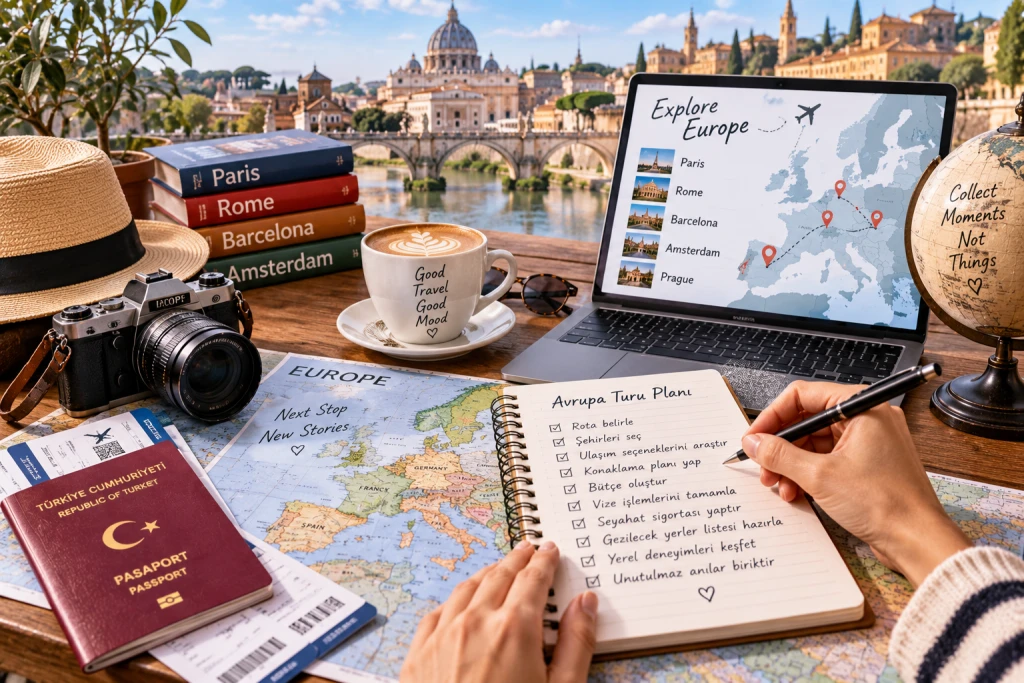
How to Plan a European Tour? Step-by-Step Guide to Planning a European Trip
Planning a European tour is not just about booking flights and hotels. Choosing the right countries, planning transportation between cities, checking visa requirements, determining accommodation areas, and preparing a balanced daily schedule will make your trip more enjoyable and hassle-free.
Whether you are traveling to Europe for the first time or have visited European cities before, with the right European tour plan, you can see more places in less time and use your travel budget more effectively.
So, how is a European tour planned? How many days should one stay in Europe? Which countries can be visited on the same tour? Is a visa required for a European tour? How should transportation and hotels be selected?
In this guide, you can find all the important steps for planning a European tour.
What Should Be Done First When Planning a European Tour?
Before starting a European tour, ask yourself these four questions:
- How many days will I travel?
- Which countries do I want to visit?
- What is my travel budget?
- What is my visa status?
Making flight or hotel reservations without answers to these questions may force you to change your itinerary later.
For example, choosing 2-3 cities instead of adding 5 different countries to a 5-day European tour can make the trip much more comfortable.
1. Determine the Duration of Your European Tour
The first step in planning a European tour is to determine the duration of your trip.
3-4 Day European Tour
Ideal for short city getaways.
For example:
- Paris
- Rome
- Prague
- Vienna
- Amsterdam
- Budapest
You can focus on a single city like these.
5-7 Day European Tour
Suitable for seeing two or three cities together.
For example:
Prague → Vienna → Budapest
or
Paris → Brussels → Amsterdam
Routes like these can be created.
8-10 Day European Tour
Can be preferred for a more comprehensive European tour.
For example:
Rome → Florence → Venice → Milan
An Italy route like this can be planned.
10-15 Day European Tour
Suitable for longer European trips involving multiple countries.
However, when increasing the number of cities, travel times must also be taken into account.
2. Decide Which Countries You Can Visit Together in Europe
When planning a European tour, it is more logical to combine cities that are geographically close to each other on the same route rather than choosing countries randomly.
For example:
Central Europe Tour
Prague → Vienna → Bratislava → Budapest
Western Europe Tour
Paris → Brussels → Amsterdam
Italy Tour
Rome → Florence → Venice → Milan
Spain Tour
Madrid → Toledo → Seville → Barcelona
Balkans Tour
Belgrade → Sarajevo → Mostar → Kotor
In this way, you can reduce long and tiring travel times between cities.
3. Check Your Visa Status for a European Tour
When planning travel from Turkey to Europe, the visa issue is one of the most important steps.
The Schengen visa, used for short-term travel to the Schengen Area, generally allows for a short-term stay of up to 90 days within any 180-day period. The Schengen Area currently consists of 29 countries.
If you are visiting multiple Schengen countries, you must base your visa application on your main destination or the country where you will stay the longest. If staying for equal durations, the country of first entry is taken into account.
When should the visa application be made?
The Delegation of the European Union to Turkey states that applications should be made at least 15 calendar days before the trip, while noting that the application process can be planned up to 6 months before the trip.
Therefore, it is important to start planning your European tour by checking your visa status.
Important Schengen development for 2026
A new graduated visa scheme was accepted in 2025 for Turkish citizens residing in Turkey and having a certain travel history. For individuals who have used two Schengen visas correctly according to regulations in the previous three years, longer-term multiple-entry visas may be possible.
Note: Since visa rules and entry conditions may change, it is important to check current information from official sources before traveling.
4. Plan Your Flight Ticket Correctly for a European Tour
Flight selection in a European tour can directly affect your total travel cost and time.
For single-city trips:
Istanbul → Paris → Istanbul
Round-trip flights like this can be preferred.
For multi-city European tours, open-jaw flights may be more convenient.
For example:
Istanbul → Rome
and return:
Milan → Istanbul
In this case, you can start in Rome, move northward, and return to Turkey from Milan.
This way, you do not spend time and transportation costs returning to the same city.
5. Plan Inter-City Transportation in Europe
One of the most important aspects of a European tour is inter-city transportation.
Main transportation options you can use:
- Train
- High-speed train
- Bus
- Plane
- Rental car
- Private transfer
Especially in cities close to each other, trains can be quite practical.
For example:
Paris → Brussels
or
Vienna → Budapest
You can consider the train option on routes like these.
However, the train may not always be the most advantageous option on every route. Ticket price, travel duration, luggage, and distance of the station from the city center should be evaluated together.
6. How Many Cities Should Be Visited on a European Tour?
One of the biggest mistakes made when planning a European tour is adding too many cities.
For example, adding a very busy route like:
Paris → Brussels → Amsterdam → Cologne → Frankfurt → Munich → Zurich
to a 7-day trip may seem theoretically possible, but in practice, it could cause you to spend the majority of your trip in transit.
A more balanced plan:
Paris → Brussels → Amsterdam
could look like this.
Simple rule:
3-4 days = 1 city
5-7 days = 2-3 cities
8-10 days = 3-4 cities
10+ days = regional route
This is not an absolute rule, but it is a good starting point for those planning their first European tour.
7. Pay Attention to the Region When Choosing a Hotel in Europe
It is not correct to choose a hotel in a European tour based only on the price.
Consider the following features of the hotel:
- Distance from the city center
- Proximity to metro or train stations
- Access to the airport
- Located in a safe area
- Breakfast option
- Room size
- Luggage storage possibility
- Check-in and check-out times
Evaluate these features.
Especially in a European tour where you will change cities, hotels near central transport hubs can provide significant advantages in terms of time.
8. Do Not Make Your Daily European Tour Program Too Busy
When preparing for a European tour, distances seen on Google Maps may appear short. However, when accounting for museum visits, restaurant breaks, public transport, and photo stops, the day passes very quickly.
Therefore, do not add too many activities to your daily program.
Example Paris itinerary:
Morning: Eiffel Tower
Noon: Lunch around the Seine River
Afternoon: Louvre and surroundings
Evening: Champs-Élysées
Preparing a more balanced program instead of squeezing 10 different tourist spots into one day will allow you to enjoy your trip more.
9. Determine Your Daily Budget for a European Tour
Do not calculate your European travel budget only through flights and hotels.
Add the following items to your total budget:
ExpenseShould It Be Considered in the Budget?Flight ticket | ✅ |
Hotel | ✅ |
Inter-city transportation | ✅ |
City transportation | ✅ |
Visa | If necessary ✅ |
Travel insurance | ✅ |
Museums and events | ✅ |
Food and drink | ✅ |
Airport transfer | ✅ |
Shopping | Optional |
Tax Free | Can be calculated additionally if refundable |
Especially in multi-city European tours, transportation expenses can constitute a significant share of the total budget.
10. Do Not Forget Travel Insurance for a European Tour
Travel health insurance is one of the important documents for Schengen visa applications.
Additionally, insurance can provide protection against some health and emergency expenses that may arise during the trip.
Therefore, it is beneficial not to leave travel insurance until the last minute when planning a European tour.
11. Plan Internet and Phone Usage in Europe
Internet access abroad is especially important for navigation, public transport, hotel, and restaurant research.
Before your trip:
- Check your operator's international packages.
- Evaluate eSIM options.
- Download maps offline.
- Save your hotel and flight information to your phone.
- Prepare digital copies of important documents.
In this way, even if you experience internet connection issues, you can still access basic travel information.
12. Apps That May Be Useful to Download on Your Phone Before a European Tour
Certain apps are quite useful during European travel.
Map app
For intra-city transportation and walking routes.
Translation app
For communication in countries where you do not speak the language.
Airline app
For flight information and check-in procedures.
Train/Bus apps
For inter-city transportation.
Hotel app
To access reservation and accommodation information.
13. Make Reservations in Advance for Museums and Popular Places in Europe
Crowds can occur at popular tourist sites in Europe.
Especially:
- Louvre
- Vatican Museums
- Colosseum
- Eiffel Tower
- Sagrada Familia
- Anne Frank House
- Uffizi Gallery
Checking tickets in advance at such heavily visited places can facilitate your travel itinerary.
While it is not mandatory to buy tickets in advance for every museum, planning high-demand spots before the trip reduces time loss.
14. Keep Your Luggage Light for a European Tour
Heavy luggage can be a serious problem on multi-city European tours.
Since you will constantly be moving:
Hotel → Train → Metro → Hotel
prepare as practical a luggage as possible.
Especially prioritize:
- Carry-on suitcase
- Backpack
- Comfortable walking shoes
- Season-appropriate clothing
- Travel adapter
- Charger
- Power bank
- Medications
- Documents
for basic needs.
15. What Season is Best for a European Tour?
The ideal period for a European tour varies depending on the country you choose and the purpose of your trip.
Spring
March, April, and May can be quite pleasant for city tours.
Advantages:
- Mild weather
- Suitable conditions for city tours
- Parks and gardens coming to life
- Quieter periods compared to summer
Summer
June, July, and August are among the busiest travel periods in Europe.
Advantages:
- Long days
- Festivals and events
- Opportunity to combine beach holidays with city tours
However, crowds and price increases can be seen in popular cities.
Autumn
September and October are particularly nice periods for cultural tours.
Winter
In November, December, and January:
- Christmas markets
- New Year's events
- Winter festivals
- Ski holidays
Different travel options stand out like these.
16. Check Schengen Border Rules When Planning a European Tour
As of 2026, there is a significant change in Europe's border management.
The Entry/Exit System (EES) digitally records the entry and exit of non-EU travelers making short-term visits to the Schengen Area. The system fully became operational at external border crossing points as of April 10, 2026.
Therefore, it is important to check your passport, visa, and border entry conditions up-to-date before your European trip.
Also, you should take into account the general 90/180 day rule for short-term Schengen travel.
17. How to Create the Best Route for a European Tour?
A good European route has three main characteristics:
1. Must be geographically logical
Avoid backtracking.
2. Travel times should be short
Do not spend the majority of the day on the road.
3. Must suit your travel style
Define your goal: culture, shopping, gastronomy, romantic getaway, or family vacation.
Most Common Mistakes Made When Planning a European Tour
❌ Trying to fit too many countries into one trip
Fewer cities can mean more experiences.
❌ Not taking travel time into account
Think about station/airport transfers as well as train or flight duration.
❌ Looking only at hotel prices
A hotel far from the center can increase daily transportation costs.
❌ Leaving the visa until the last minute
Evaluate the visa process at the very beginning of your travel plan.
❌ Creating overly busy daily programs
Leave some free time for each day.
❌ Not planning airport transfers
It is beneficial to organize transfers in advance, especially for late-night or early-morning flights.
❌ Ignoring travel insurance
Especially for Schengen trips, check insurance requirements in advance.
European Tour Planning Checklist
You can check the following list before your trip:
- Passport validity checked.
- Visa status checked.
- Main destination determined.
- Flight ticket purchased.
- Inter-city transportation planned.
- Hotels selected.
- Airport transfers planned.
- Travel insurance obtained.
- Museum and event tickets checked.
- Daily sightseeing program prepared.
- Internet/eSIM planned.
- Money and card options prepared.
- Luggage packed.
- Digital copies of important documents created.
- Travel budget determined.
European Tour Package Tour or Independent Travel?
There are two main options when planning a European tour.
Independent European Tour
You create your own itinerary.
Advantages:
- Flexible schedule
- Choose your own hotel
- Set your own travel pace
- Add cities you want
However, you need to organize everything including flights, hotels, transportation, transfers, museums, and daily programs.
Package European Tour
Transportation, accommodation, guidance, and some activities can be offered within a single program.
Advantages:
- More organized schedule
- Ease of organization
- Guide support
- Convenience on multi-city routes
- Ease for those traveling to Europe for the first time
Organized European tours can be considered especially for your first European trip or if you want to see many cities in a short time.
When Should Reservations Be Made for a European Tour?
As the travel date approaches, flight and accommodation options may change.
Especially during:
- Summer holidays
- Christmas season
- New Year
- Easter period
- Festivals
- Major sporting events
- Fair periods
Early planning can offer more options during busy times like these.
For trips requiring a visa, it is important to evaluate the visa process and travel plan together first.
Plan Your European Tour Now
When planning a European tour, the most important point is to create the right route instead of trying to see too many places and prepare your trip with a realistic schedule.
In an ideal European tour:
Determine your route → Check your visa status → Plan your flight → Choose inter-city transportation → Select your hotel → Create your daily program → Get travel insurance → Complete your reservations.
You can take your first step to discover Europe today.
Determine your holiday dates → Choose your European route → Compare flight and hotel options → Create a tour program suitable for you → Complete your reservation.
A properly planned European tour means less time wasted and more discovery.