


Tips for Your First Solo Trip
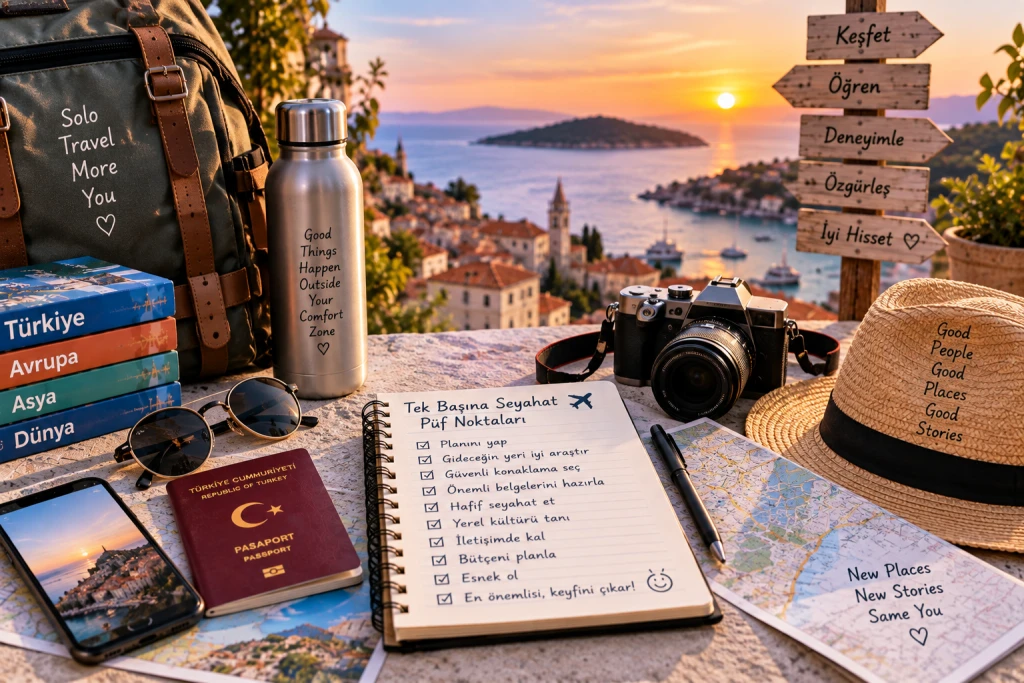
Tips for Your First Solo Trip | 2026 Solo Travel Guide
Solo travel may initially require a bit of courage. However, with proper planning, solo travel can transform into an unforgettable experience that enhances the feeling of freedom and helps you get to know yourself better.
Setting your own schedule, staying longer in places you like, getting lost on an unplanned street to discover new spots, or simply resting whenever you want... The best part of solo travel is that all decisions are entirely up to you.
So, what should you pay attention to when traveling alone for the first time? How do you plan a safe solo trip? Which destinations should be chosen for a first journey?
In this guide, you can find the most important tips, from planning to accommodation, security to budget, for those traveling alone for the first time.
What is Solo Travel?
Solo travel means carrying out your journey according to your own plan, without being tied to any friends, family members, or tour groups.
Solo travel does not mean being completely unplanned. On the contrary, especially if you are traveling alone for the first time, preparing transportation, accommodation, budget, security, and emergency plans in advance will make your trip much more comfortable.
Moreover, traveling alone does not necessarily mean spending the entire vacation by yourself. If you wish, you can join city tours, participate in group activities, or meet new people during your trip.
15 Important Tips for Those Traveling Alone for the First Time
1. Don't Choose a Very Difficult Route for Your First Trip
Instead of going to the other side of the world for your first solo trip, choosing a destination that is easier to reach and has developed tourist infrastructure will make things easier.
For your first trip:
- Cities with easy access,
- Destinations with developed public transport,
- Tourist areas,
- Places with many accommodation options,
- Countries where you can feel more comfortable with language and communication
you can consider these.
The goal of your first solo trip is not to challenge yourself, but to get used to traveling alone.
2. Research Your Destination Before the Trip
Knowing your destination beforehand provides a great advantage when traveling alone.
Research the following topics before your trip:
- City safety
- Transportation from the airport to the city center
- Public transport
- Accommodation area
- Places to visit
- Local transport costs
- Weather conditions
- Local culture and traditions
- Entry and visa requirements
- Emergency numbers
- Health services
- Nighttime transportation
Official travel sources also recommend checking entry conditions, local laws, security status, and health information about the destination before the trip.
3. Arrange Your First Night's Accommodation in Advance
When traveling alone, it is very important to know where you will stay on the first night in advance.
Looking for a hotel after landing, wandering around an unfamiliar city with luggage, or trying to find accommodation late at night can create unnecessary stress.
When choosing a hotel:
- Central location,
- Proximity to public transport,
- Safety of the area,
- Guest reviews,
- 24-hour reception,
- Access from the airport,
- Availability of restaurants and markets nearby
evaluate these criteria.
It is recommended for solo travelers to research their accommodation in advance and, if possible, be aware of alternative accommodation options for security reasons.
4. Don't Overload Your Itinerary
One of the most common mistakes made by those traveling alone for the first time is trying to see too many places in a short time.
For example, instead of visiting 15 different spots in a 3-day city holiday, planning 3-4 main activities per day might be more comfortable.
Your schedule must include:
- Rest time,
- Meal breaks,
- Travel times,
- Unexpected situations
leave room for these.
The goal of solo travel is not to consume a city, but to experience it.
5. Plan Your Transportation in Advance
When traveling alone, planning your first and last transportation points in advance provides comfort.
For example:
Airport → Hotel → City Center → Hotel
determine your basic transportation chain in advance.
Research how you will get from the airport to your hotel. If necessary, book a transfer reservation.
Official travel safety guides recommend that solo travelers use reliable and licensed transportation options and organize airport transfers in advance.
6. Prepare Your Phone and Internet
When traveling alone, your phone becomes almost your travel companion.
Make sure your phone has:
- Offline maps,
- Translation apps,
- Hotel reservation details,
- Flight tickets,
- Travel insurance information,
- Emergency numbers,
- Banking apps,
- Transportation apps
installed.
Also, carrying a power bank will be useful to ensure your phone battery doesn't run out.
Downloading the map of the area you are visiting offline in advance is also a good idea so you can use it when there is no internet connection.
7. Inform Your Loved Ones About Your Travel Plans
Even if you are traveling alone, you should not have a circle of people who are completely unaware of your trip.
You can send a trusted person:
- Your flight details,
- Hotel name,
- Hotel address,
- Travel dates,
- Cities you will visit
etc.
Especially for international trips, agreeing to communicate at regular intervals can be beneficial.
Solo travel guides particularly recommend sharing your travel plan with a trusted person at home.
8. Prepare Copies of Your Documents
You can store digital copies of documents such as passport, ID, visa, travel insurance, flight ticket, and hotel reservation on your phone and in a secure cloud account.
Also, keeping a physical copy of important documents in a separate place is beneficial.
Try not to carry the original document and its copy in the same place.
9. Don't Carry All Your Money in One Place
When traveling alone, keeping all your money and cards in one place can be risky.
For example:
- A certain amount of cash,
- A bank card,
- A backup card,
- Emergency funds
can be kept in different places.
Also, try not to carry much more cash than your daily needs.
10. Be More Careful Late at Night
Exploring a city during the day is not the same as walking alone at night.
Especially in a city you are visiting for the first time:
- Avoid deserted streets,
- Dark parks,
- Unfamiliar neighborhoods,
- Long walks alone at night
it may be a safer choice to avoid these.
Use reliable transportation to return to your accommodation at night.
GOV.UK recommends that solo travelers avoid poorly lit areas, especially at night, and choose reliable transportation options.
11. Keep Valuable Items Out of Sight
Do not constantly carry expensive watches, jewelry, large amounts of cash, or eye-catching electronic devices visibly.
Keep your bag under control especially:
- At airports,
- Train stations,
- Bustling markets,
- Tourist squares,
- On public transport
etc.
Carrying valuable items discreetly and as securely as possible is among the basic travel safety recommendations.
12. Don't Trust Everyone You Meet
One of the best parts of solo travel is meeting new people.
However, do not give newly met people:
- Your hotel room details,
- Passport information,
- Bank details,
- All details of your travel plans,
- Money and card information
etc.
Strike a balance between being warm-hearted and not letting your guard down.
If your instincts tell you that a situation is not safe, leave the environment.
13. Do Not Neglect Travel Insurance
When traveling alone, travel insurance that can help you in unexpected situations may be important.
Before purchasing your policy:
- Emergency medical expenses,
- Hospital costs,
- Medical evacuation,
- Trip cancellation,
- Baggage loss or delay
check whether these coverages are included in the policy and what their limits are.
Since the scope and exclusions of travel insurance can vary by policy, comparing coverage is more correct than just comparing prices. Official travel guides also recommend evaluating appropriate insurance coverage before the trip.
14. Respect Local Rules and Culture
Every country, and sometimes even every city, may have different cultural and social rules.
Before your trip:
- Clothing rules,
- Photography bans,
- Rules in religious places,
- Public transport rules,
- Alcohol and smoking regulations,
- Local behavior patterns
research these.
Being informed about local laws and traditions in advance helps you prevent unnecessary problems.
15. Don't Try to Control Everything
One of the best parts of solo travel is your ability to act spontaneously.
Sometimes you may prefer to sit in a small café instead of going to the museum you planned, explore a neighborhood you never planned to visit, or dedicate your whole day to rest.
Allow yourself this.
You don't have to plan every minute of your trip.
Packing List for Solo Travel
Not carrying too much luggage is a great advantage in solo travel.
You can keep the following in your bag:
Documents
- Passport/ID
- Visa
- Flight ticket
- Hotel reservation
- Travel insurance
- Digital document copies
Electronics
- Phone
- Charger
- Power bank
- Headphones
- Travel adapter
Personal Needs
- Medicines
- Small first aid kit
- Hygiene products
- Sunscreen
- Water bottle
Daily Use
- Small backpack
- Comfortable shoes
- Clothes suitable for the weather
- Small lock
- Sunglasses
Things Not to Do When Traveling Alone
Avoid the following mistakes on your first solo trip:
❌ Don't carry all your money in one place.
❌ Don't leave your passport unattended.
❌ Don't walk alone in unfamiliar areas at night.
❌ Don't give personal information to strangers.
❌ Don't set off without sharing your travel plan with anyone.
❌ Don't choose accommodation only because it's the cheapest.
❌ Don't leave transportation options until the last minute.
❌ Don't let your phone battery die completely.
❌ Don't check entry and visa conditions of the country you are visiting at the last moment.
❌ Don't over-schedule your itinerary.
Is Solo Travel Different for Women?
Women may benefit from paying a bit more attention to security planning in their solo travels.
Especially:
- Choosing the accommodation area carefully,
- Planning nighttime transportation in advance,
- Using reliable transfers,
- Maintaining regular contact with loved ones,
- Not sharing personal information,
- Being moderate with alcohol consumption,
- Leaving uncomfortable environments early
may be important.
Since risks can vary by destination, checking current official travel advisories before the trip is the right step.
Top 10 Rules for Your First Solo Trip
To summarize briefly:
- Choose an easy destination.
- Arrange your first night in advance.
- Research your transportation.
- Share your travel plan with a loved one.
- Back up your documents.
- Keep your phone and internet ready.
- Be careful with your valuables.
- Be more cautious when walking alone at night.
- Evaluate travel insurance.
- Don't try to plan everything perfectly.
Is Solo Travel Scary?
It is extremely normal to feel some excitement and nervousness during the first few hours or the first day.
This feeling will gradually diminish when you find your hotel after leaving the airport, go to a restaurant alone for the first time, or find your way around the city on your own.
After a while, you may realize how liberating solo travel actually is.
Because solo travel not only shows you new cities; it also teaches you to trust your own decisions and handle different situations alone.
Plan Your First Solo Trip Now
If you are going to travel alone for the first time, the most important point is to prepare well but not worry more than necessary.
Choose the right destination, arrange safe accommodation, plan your transportation, prepare your documents, and share your travel plan with someone you trust.
After that, it's time to explore.
If you are ready to plan your first solo trip; determine your travel date, evaluate flight and accommodation options suitable for you, and create a travel program that meets your needs.
Remember: Your first solo trip could be the beginning of your future journeys.