


How to Determine a Travel Route?
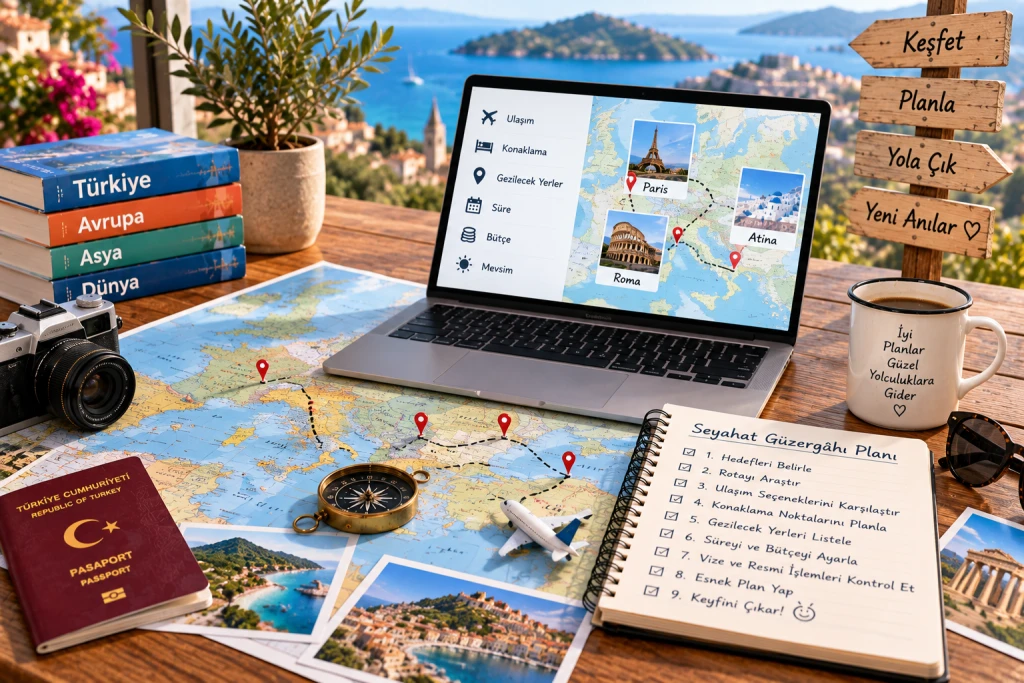
How to Determine a Travel Itinerary? | 2026 Route Planning Guide
The enjoyment of a trip depends not only on choosing the right destination. Correctly determining your travel itinerary helps you waste less time during your vacation, avoid unnecessary transport costs, and explore more places comfortably.
Especially in trips covering multiple cities or countries, an improperly created route can lead to long journeys, unnecessary hotel changes, and most of your vacation being spent on the road.
So, how is a travel itinerary determined? What should be considered when creating a travel route? In what order should multiple cities be visited?
In this guide, you can find the steps to create the right itinerary for different types of trips, from a short weekend getaway to a long-term European tour.
What is a Travel Itinerary?
A travel itinerary is the planning of places to visit during a trip and the transportation connections between these places in a specific order.
To give a simple example:
Istanbul → Thessaloniki → Athens → Santorini
is a travel itinerary plan.
However, a good itinerary is not just a list of cities to visit.
A well-prepared route;
- Considers travel duration,
- Distance between cities,
- Duration of stay,
- Budget,
- Purpose of the trip,
- Season,
- Location of places to visit,
- Transport alternatives
all together.
What Should Be Done First When Determining a Travel Itinerary?
Before starting to create a travel route, answer these 5 questions:
1. How many days will I travel?
A 3-day vacation and a 15-day European tour are not planned with the same itinerary.
2. Where do I want to go?
First, determine your main destinations that you want to see.
3. What is the purpose of the trip?
- Beach holiday
- Cultural tour
- Nature holiday
- Gastronomy
- Shopping
- Adventure
- Honeymoon
- Family vacation
- Business trip
purposes like these change the shape of the route.
4. How will I get around?
- Plane
- Train
- Bus
- Car
- Ferry
- Rental car
evaluate these options.
5. What is my travel budget?
Seeing more cities is not always more economical. As you change cities, transport and accommodation costs can also increase.
1. Determine Your Travel Duration
The first step in creating a travel itinerary is clarifying the travel duration.
For example, planning 5 different cities in a 4-day vacation might cause you to spend most of your trip on the road.
Instead:
4 days → 1 or 2 main destinations
you can create a more balanced route.
In longer trips, the number of cities can be increased.
Example:
3-day vacation: 1 city
5-day vacation: 1-2 cities
7-day vacation: 2-3 cities
10-day vacation: 3-4 cities
15-day vacation: 4-6 cities
These are not absolute rules. The travel time between cities and travel style can change these numbers.
2. List the Places You Want to See
It is easier to list the places you want to see first rather than starting directly from the map to create a route.
For example, if you are planning a trip to Italy:
- Rome
- Florence
- Venice
- Milan
- Naples
you can prioritize these destinations.
Afterwards, you can examine the transport connections between these cities.
Answer the question "Where do I want to go?" first, then answer "In what order should I go?".
3. Mark Destinations on the Map
Using a map while creating a travel route provides great convenience.
Mark all the cities you want to visit on the map and compare their locations relative to each other.
This way, at first glance:
- Cities located in the same region,
- Unnecessary backtracking,
- Very long distances,
- More logical route alternatives
you can see.
Trip planning tools that include multiple destinations can make it easier to create the route and change the order of destinations.
4. Arrange Cities in a Logical Order, Not Randomly
One of the most important aspects of a travel route is the order of the cities.
For example:
Istanbul → Rome → Paris → Barcelona → Rome → Istanbul
instead, if flight and transport options allow:
Istanbul → Rome → Paris → Barcelona → Istanbul
a route like this could be more efficient.
The goal in such routes is to avoid returning unnecessarily to the same point.
Basic rule:
Instead of going back where you have been, create a route that moves forward as much as possible.
This can save time, especially in European tours and multi-city trips.
5. Compare Departure and Return Airports
In multi-city trips, you do not always have to enter and exit from the same airport.
For example:
Istanbul → Rome → Florence → Venice → Istanbul
instead, depending on flight options:
Istanbul → Rome → Florence → Venice → Milan → Istanbul
you can create a route like this.
Even in some trips:
Istanbul → Rome
and
Milan → Istanbul
entering and exiting from different airports might be more logical.
Such trips are generally called open-jaw / multi-point flight planning.
6. Look at Transport Time, Not Just Distance
Looking only at kilometers when creating a travel itinerary can be a big mistake.
Even if the distance between two cities looks short:
- Traffic,
- Transfers,
- Airport transfers,
- Train connections,
- Ferry schedules,
- Border crossings
can increase total travel time.
Therefore:
"How many kilometers?" instead ask "How many hours does it take?"
question.
Clearly showing transport time in travel plans makes it easier to evaluate whether the route is realistic. In VisitBritain's sample itineraries, train times between cities are also specified separately.
7. Choose the Mode of Transport According to Your Travel Style
Using a plane for every route is not the best solution.
In some routes, trains may be faster and more comfortable. In some destinations, however, a rental car may provide much more freedom.
Compare transport options:
TransportAdvantageBest ForTravelTypePlane | Fast over long distances | Intercontinental |
Train | City center to city center transport | European cities |
Bus | Economic options | Short/Medium distance |
Rental car | Flexible route | Nature and rural routes |
Ferry | Island and coastal routes | Greek Islands etc. |
Private transfer | Comfortable | Families and private groups |
Especially in regions with strong train connections, using intercity trains can reduce extra time like going to the airport and security procedures.
8. Do Not Extend Daily Travel Time Too Much
When creating a travel itinerary, traveling for hours every day can reduce the enjoyment of the vacation.
Especially:
06:00 AM → Transport → Lunch check-in → Evening transport again
schedules like this can become exhausting after a few days.
Therefore, as much as possible:
Sightseeing → Accommodation → Rest
maintain the balance.
9. Choose Accommodation Based on the Itinerary
Once the route is determined, choosing a hotel becomes easier.
For example, if you are staying in a city for only one night, pay special attention to the location of the hotel.
When choosing a hotel:
- Is it close to the train station?
- Is access to the airport easy?
- Is it far from the city center?
- Is public transport available?
- How long does it take to reach sightseeing spots?
- If driving, is there parking?
ask these questions.
A good itinerary can become inefficient with a hotel chosen in the wrong location.
10. Plan Places Located in the Same Region on the Same Day
Considering geographical location when creating a daily route saves a lot of time.
For example, in Istanbul:
Sultanahmet → Hagia Sophia → Topkapi Palace → Basilica Cistern → Grand Bazaar
planning points close to each other within the same day can be more efficient than constantly going back and forth between different parts of the city.
The same method can be used in European cities, island holidays, and cultural tours.
Simple rule:
Group nearby places → Put them on the same day → Reduce transport time.
11. Leave a "Free Day" in Your Trip
You do not have to fill every day completely.
Especially in long trips, leaving a day or a few hours of a day free is beneficial.
This time can be used for:
- Resting,
- Shopping,
- Discovering local restaurants,
- Seeing an unplanned area,
- Changing the schedule according to weather
.
Flexibility must always be present in a good travel program.
12. Include the Season in the Itinerary
A travel itinerary should not be determined solely based on the map.
The season also has a significant impact on the route.
In summer months
- Coastal routes
- Islands
- Boat tours
- Outdoor activities
may come to the fore.
In winter months
- Ski resorts
- Christmas markets
- Winter festivals
- Thermal destinations
may be more suitable.
In spring and autumn
- Cultural tours
- Nature routes
- City tours
- Hiking routes
can be planned more comfortably.
13. Reflect Your Travel Purpose in the Itinerary
Different routes can be created entirely for the same destination depending on different travel purposes.
Cultural tour
Route focused on historical cities and museums.
Honeymoon
Less hotel changes and more rest.
Family vacation
Short transport times and child-friendly activities.
Adventure holiday
Nature, trekking, rafting, and outdoor activities.
Gastronomy tour
Local restaurants, markets, and gastronomy centers.
The right itinerary is not the same for everyone.
14. Calculate Budget Together with the Route
The cost of a trip is not determined only by hotels and flight tickets.
As the route changes:
- Transport,
- Luggage,
- Transfer,
- Accommodation,
- City transport,
- Activities
costs can also change.
For example, changing hotels in three different cities during a 7-day vacation may create more transport and time costs compared to staying in a single city.
Therefore, calculating the route first, then the total budget may be a more correct approach.
15. Check Transport Schedules When Creating the Itinerary
There may be routes where transport from one city to another happens only a few times a day.
For example, consider a ferry or train operating at:
09:00 – 14:00 – 19:00
times.
In this case, choosing the 19:00 departure may affect your hotel check-in in the target city or your schedule for the next day.
Therefore, when determining the route:
Distance + Transport time + Departure time + Arrival time
should be evaluated together.
16. Consider Transfers
Especially in international trips, transfer-based transport options can be significant on the route.
A route may consist of several different modes of transport:
Plane → Train → Ferry → Bus
like this.
In this case, sufficient time must be left for each connection.
Leaving more time buffer is especially important for connections made with separate tickets.
17. Do Not Add Too Many Cities
One of the most common mistakes made when creating a travel itinerary is the thought of "Since I'm already here, I'll see this place too."
For example, adding to a 7-day European tour:
- Paris
- Brussels
- Amsterdam
- Berlin
- Prague
- Vienna
- Budapest
may seem theoretically possible, but in practice, most of the trip may be spent on transport.
Instead, focusing on 2-3 nearby destinations in a 7-day trip may be more enjoyable.
18. Try the 80/20 Rule in Your Travel Itinerary
It is not possible to see everything on every trip.
Therefore, approximately:
80% of the route planned, 20% flexible
can be.
For example:
- Morning → Planned activity
- Afternoon → Planned area
- Evening → Free time
you can create a schedule like this.
This approach allows you to move both in a planned manner and dedicate time to spontaneous discoveries.
19. Save Your Travel Route Digitally
Instead of writing your route only on paper, you can also save it digitally.
On your phone:
- Hotel locations
- Airports
- Train stations
- Restaurants
- Museums
- Transfer points
- Emergency points
can be marked.
Travel planning tools allow saving multiple destinations and later changing the order of the route.
20. Check Your Travel Itinerary One Last Time
After the route is completed, answer the following questions one by one:
- How will I get from the first city to the second?
- How long does the transport take?
- Is the hotel close to the transport point?
- Is the daily schedule too busy?
- Am I returning to the same place?
- Is there enough time between transfers?
- What is the total transport cost?
- Are the weather conditions suitable?
- Are there visa or entry requirements?
- Do I have travel insurance?
- Have I left enough time to rest?
This check allows you to identify problems in the route before the trip begins.
Sample Route Formula for Travel Itinerary
To create a practical route, you can use the following formula:
Starting Point
↓
Main Destination
↓
Nearby Destination
↓
Regional Destination
↓
Last Destination
↓
Return Point
For example:
Istanbul → Thessaloniki → Athens → Santorini → Istanbul
such a route can be an example of a travel plan that takes start and end points into account.
10 Mistakes Made When Determining a Travel Itinerary
1. Adding too many cities
Makes the trip exhausting.
2. Looking only at kilometers
You may miss the actual transport time.
3. Not considering transfer times
Can create a risk of missing connections.
4. Changing hotels every night
Can reduce rest time.
5. Creating a route without looking at the map
Can cause unnecessary backtracking.
6. Not taking weather into account
Can cause problems especially in outdoor activities.
7. Thinking about budget after the route
Transport costs may turn out higher than expected.
8. Choosing very early or very late transport
Can disrupt the daily schedule.
9. Not leaving free time
Can cause the vacation to pass stressfully.
10. Thinking about the return route later
Can cause unnecessary time loss on the last day.
Checklist for Preparing a Travel Itinerary
Before completing your travel plan:
- I determined the travel duration.
- I selected main destinations.
- I marked destinations on the map.
- I determined the order of cities.
- I checked transport times.
- I compared transport options.
- I chose hotels according to the route.
- I checked transfer times.
- I balanced the daily schedule.
- I left time for rest.
- I checked the weather.
- I calculated the total budget.
- I checked departure and return transport.
- I made important reservations.
- I saved my travel plan digitally.
Most Practical Method for Preparing a Travel Itinerary
To summarize, to create a good travel route, you can follow this order:
1. Determine travel duration.
↓
2. List the places you want to see.
↓
3. Mark places on the map.
↓
4. Group nearby destinations.
↓
5. Put cities in a logical order.
↓
6. Compare transport times.
↓
7. Determine accommodation points according to the route.
↓
8. Create the daily schedule.
↓
9. Calculate the budget.
↓
10. Check the route one last time and complete reservations.
This method can be used for both short vacations and long multi-city trips.
A Good Travel Route Is Not About Seeing More Places, But About Wasting Less Time
Determining a travel itinerary is not just about listing cities to visit. A correct route; should evaluate travel duration, transport options, accommodation, budget, season, and the purpose of the trip together.
The best travel route is not the one that covers the most cities.
The best route is the one that wastes the least time for you, fits your budget, and allows you to enjoy your trip.
In multi-city trips, evaluating destinations on a map, comparing transport times, and avoiding backtracking as much as possible makes planning easier. Current travel planning tools also make it easier to organize multiple destinations in a single route and reorder the route.
Plan Your Trip with the Right Itinerary
After determining your travel dates and the places you want to see, evaluate transport, hotel, transfer, and tour options together.
Determine your travel route → Compare transport options → Choose hotels on the route → Create your daily schedule → Complete your reservation.