


Most Common Mistakes Made While Traveling
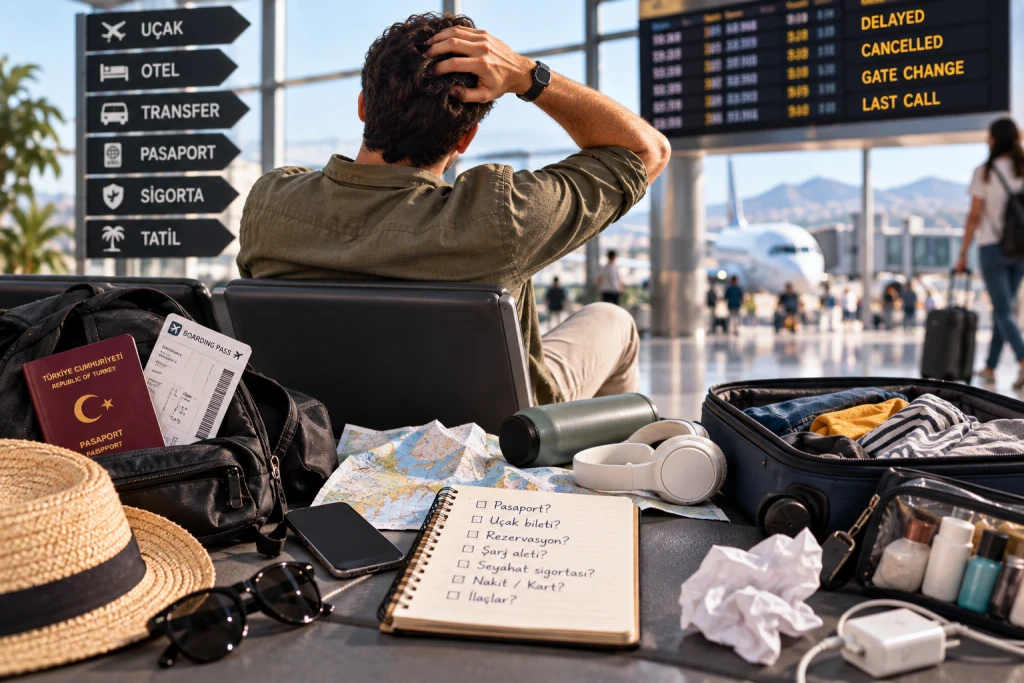
Most Common Mistakes Made While Traveling | 2026 Travel Guide
Traveling is a great opportunity to discover new places, get to know different cultures, and escape daily routines. However, some small mistakes can ruin the enjoyment of your vacation, making the trip unnecessarily stressful and expensive.
Especially mistakes made during international travel can arise in many different areas, from visa and passport controls to choosing the wrong hotel, carrying too much luggage, or poor transport planning.
So, what are the most common mistakes made when planning a trip? Knowing the most common mistakes made while traveling in advance can help you protect your budget and enjoy your vacation more comfortably.
In this guide, you can find the most common mistakes made before, during, and throughout your vacation, as well as how to avoid them.
1. Leaving Trip Planning Until the Last Minute
One of the most common travel mistakes is leaving vacation planning until the last minute.
Early planning for flights, hotels, car rentals, transfers, and some popular activities can offer more options. Especially during busy periods like summer season, holidays, New Year's, and public holidays, last-minute plans can limit your choices.
What should you do?
As early as possible before your trip:
- Research transportation options.
- Compare hotel alternatives.
- If a visa is required, check the application deadline.
- Evaluate travel insurance.
- Plan airport transfers.
- Roughly create your daily sightseeing route.
Early planning can provide advantages not only in terms of price but also in terms of options.
2. Not Checking Passport and Visa Requirements
One of the most serious mistakes made during international travel is checking passport and visa requirements at the last minute.
A country being visa-free does not necessarily mean there are no other conditions for entry. Some countries may require additional conditions such as passport validity period, travel insurance, accommodation details, return tickets, or proof of financial means.
The Ministry of Foreign Affairs of Turkey also recommends checking passport validity, visa regulations, and special entry conditions of the country before leaving abroad.
Pre-travel checklist:
- Is the passport valid?
- Are there enough blank pages in the passport?
- Is a visa required?
- Does the visa duration cover the travel dates?
- Is a visa required for transit countries?
- Is travel insurance mandatory?
- Is a special document required for entry to the country?
Checking visa and entry conditions before setting your travel date can prevent last-minute problems.
3. Calculating Travel Budget Based Only on Flight Tickets
Another common mistake is calculating the travel budget solely based on flight tickets.
However, the total vacation cost should be considered as;
Flight + Hotel + Transfer + Local Transport + Food & Drink + Activities + Travel Insurance + Extra Expenses
.
For example, you might find an affordable flight ticket, but if the airport is far from the city center, it could increase transfer costs.
A more accurate budget plan
4. Choosing a Hotel Solely Based on Price
One of the most common mistakes made while planning a trip is automatically assuming the cheapest hotel is the best option.
When choosing a hotel, besides the price, the following features should also be considered:
- Location
- Distance from the airport
- Public transport connections
- Proximity to the beach or city center
- Parking
- Breakfast
- Room type
- Cancellation policies
- Guest reviews
- Suitability for children
- Extra fees
Especially for city trips, paying a little more for a centrally located hotel can reduce transportation costs and time loss.
Choosing the right hotel is one of the most important parts of the travel experience.
5. Planning Every Minute of the Trip
Making a travel plan is important, but filling the schedule too much can reduce the enjoyment of the vacation.
A program starting early in the morning, continuing with back-to-back museum and tour programs, and lasting late into the night can become exhausting after a few days.
For a better travel plan:
- Determine a few main activities per day.
- Leave free time for rest.
- Factor in travel times.
- Don't try to visit a different area every day.
- Leave time for unexpected situations.
A good vacation program is not about seeing as many places as possible; it is about enjoying the places you see.
6. Underestimating Travel Times
Two points that appear close together on a map can be quite far apart in real life due to traffic, public transport, transfers, or walking times.
Especially when creating a daily program in large cities, you need to look not only at distance but also at travel time.
For example:
Hotel → Museum → Restaurant → Beach → Airport
If you are creating a route like this, calculate the travel time to each point in advance.
This method can significantly reduce time loss, especially for short city trips.
7. Not Allowing Enough Time for Connecting Flights
Connecting flights may be more suitable than direct flights, but the connection time must be evaluated correctly.
There can be significant differences between connections on the same ticket and self-transfers made with separate tickets.
With separate tickets, processes such as baggage claim, re-check-in, security checks, or terminal changes may be required.
Therefore, before purchasing a connecting flight:
- Check the layover time
- Check the airport
- Check for terminal changes
- Check if baggage is checked through to the final destination
- Check if a transit visa is required
- Check if they are separate tickets
.
8. Not Checking Baggage Allowance
One of the simple but costly mistakes made before the flight is not checking the baggage allowance.
Baggage weight and cabin baggage rules can vary depending on the airline, ticket class, and route. Therefore, it is not correct to assume a general standard applies to all airlines.
Check before the flight:
- Cabin baggage dimensions
- Cabin baggage weight
- Checked baggage allowance
- Extra baggage fees
- Sports equipment rules
- Baby baggage
- Special item rules
Additionally, airline and security rules regarding the transport of power banks and spare lithium batteries must be checked; IATA states that spare batteries and power banks must be carried in cabin baggage.
9. Storing Passport and Important Documents in One Place
Carrying your passport, ID, bank cards, and all documents in the same bag is risky.
If your bag is lost or stolen, you could lose all your important documents at once.
The Ministry of Foreign Affairs of Turkey also recommends safely backing up documents such as passport copies, travel information, and insurance policies and sharing them with close contacts.
Practical method:
You can backup your documents in different locations such as:
- Physical copy
- Phone
- Cloud storage
.
However, be careful to keep these files in secure accounts to protect your personal data.
10. Not Researching Local Rules and Culture
Every country and city has its own unique rules.
Dress codes, behavior in religious places, photography rules, use of public transport, alcohol consumption, or the legal implications of certain behaviors can vary from country to country.
The Ministry of Foreign Affairs of Turkey particularly recommends researching the laws, security situation, and local customs of the country you are visiting before your trip.
Before going on vacation, research the country you are visiting not only from a tourist perspective but also from cultural and legal perspectives.
11. Considering Travel Insurance Unnecessary
The thought "I'm just going for a few days, nothing will happen to me" is one of the important mistakes made while traveling.
During travel, health problems, baggage issues, flight disruptions, or other risks included in the policy may arise.
Since the coverage of travel insurance varies by policy, you need to look not only at the price but also at coverage limits, exclusions, and exceptions.
In some countries, travel health insurance may be one of the entry requirements. For example, Georgia requires Turkish citizens traveling with a general-purpose passport or identity card to have travel health/accident insurance with specific coverage and guarantee conditions as of January 1, 2026.
12. Carrying Only Cash
Carrying the entire budget in cash during international travel is not a safe method.
Relying solely on a single bank card can also cause problems.
A safer approach is to create alternatives such as:
- A certain amount of cash
- Main bank card
- Backup card
- Emergency fund
.
It may be beneficial to save the bank's foreign contact number in advance in case cards are lost or stolen.
13. Not Making a Phone and Internet Plan
Lack of internet connection abroad can cause serious problems, especially in a country visited for the first time.
Internet connection may be needed for maps, banking apps, reservation details, transport apps, and communication.
Before your trip:
- Compare roaming packages
- eSIM options
- Local SIM cards
- Wi-Fi availability
- Offline maps
.
Especially when using mobile internet abroad, it is important to check your operator's current pricing before your trip.
14. Arriving Late at the Airport
The thought "Traffic won't be bad" or "I'll handle the check-in process quickly" can cause problems, especially during busy periods.
When calculating travel time to the airport:
- Traffic
- Parking
- Airport entrances
- Baggage drop-off
- Security check
- Passport control
- Terminal distance
consider these stages.
Especially for international flights, it is necessary to take into account the arrival time recommended by the airline at the airport.
15. Leaving Restaurant and Activity Reservations Until the Last Minute
Popular restaurants, boat tours, museums, special events, and guided tours can fill up quickly during busy periods.
Especially during periods such as:
- Honeymoon
- New Year
- Holidays
- Summer season
- Festivals
- Weekend getaways
it may be more correct to plan important activities in advance.
However, instead of filling the entire schedule in advance, securing priority activities provides a more flexible trip.
16. Not Checking the Weather
When packing your travel bag, looking only at the season is not enough.
Temperature, precipitation, and wind conditions can change significantly in different cities even within the same season.
Especially in destinations such as:
- Cappadocia
- Black Sea Region
- Mediterranean
- Balkans
- Northern Europe
- Mountainous regions
it is important to check weather conditions again close to the travel date.
17. Bringing Too Many Items
The thought "Maybe I'll need it" can cause the travel bag to become larger than necessary.
Too many items can cause problems such as:
- Difficulty carrying
- Baggage fees
- Waiting at the airport
- Space problems in the vehicle
- Difficulties when changing hotels
.
Preparing clothes that can be combined according to the length of the trip and weather conditions is more practical.
18. Not Setting Aside an Emergency Fund in the Travel Budget
Planning the vacation budget down to the last penny may sound logical. However, everything may not go according to plan during travel.
Situations such as transportation changes, unexpected expenses, health issues, or extra accommodation may arise.
Therefore, it is beneficial to set aside a portion of the total travel budget as an emergency fund.
19. Believing Every Travel Recommendation on Social Media
An hotel, restaurant, or tour seen on social media may not always meet expectations.
Especially regarding:
- Excessively discounted vacation offers
- Unrealistic villa listings
- Fake hotel websites
- People asking for payment to personal accounts
- Ambiguous cancellation policies
caution should be exercised.
It is important to check the authenticity of the business, contact information, reservation terms, and payment conditions before making a reservation.
20. Trying to Do Everything in One Day
The thought "I want to see everything" in a city is one of the most exhausting mistakes in travel.
Especially for short trips of 2-3 days, focusing on a specific area rather than adding too many regions to the schedule may be more enjoyable.
For example:
Day 1: Historical district + city center
Day 2: Museum + local experiences
Day 3: Free time + shopping
A balanced program like this can be prepared.
21. Not Establishing a Connection Between Transport and Accommodation
When choosing a hotel, evaluate the transport network in addition to just the room features.
For example, choosing a very cheap hotel far from the city center may increase your total travel cost if you need to use a taxi every day.
Therefore, when choosing a hotel, ask yourself this question:
"How will I get to the places I want to visit every day if I stay at this hotel?"
This simple question can prevent wrong hotel choices.
22. Not Leaving Flexibility in the Travel Plan
Flights may be delayed, the weather may change, a museum may be closed, or you may encounter a place where you want to spend more time than expected.
Therefore, a good travel program must include some flexibility.
Your plan should be a guide, not a rule that controls you.
15-Point Checklist to Prevent Mistakes Made While Traveling
You can check the following list before going on a trip:
- Passport validity period checked.
- Visa requirements checked.
- Flight times checked.
- Baggage allowance checked.
- Hotel reservation confirmed.
- Transfer planned.
- Travel insurance evaluated.
- Important documents backed up.
- Phone and internet planned.
- Bank cards checked.
- A certain amount of local currency prepared.
- Weather checked.
- Emergency fund set aside.
- Reservations made for important activities.
- Important rules of the country to be visited researched.
What Are the Most Common Mistakes Made While Traveling?
We can briefly list the most common travel mistakes as follows:
- Leaving the trip until the last minute
- Not checking visa requirements
- Not checking passport validity period
- Making a budget based only on flight tickets
- Choosing a hotel solely based on price
- Creating a very intensive travel program
- Not factoring in travel times
- Not checking baggage rules
- Not backing up documents
- Not valuing travel insurance
- Not making a phone and internet plan
- Not researching local rules
- Carrying all money in one place
- Trusting every travel recommendation on social media
- Not setting aside an emergency fund
The Most Correct Approach for a Flawless Trip
A good travel plan actually consists of three basic stages:
1. Research Before the Trip
Check destination, visa, passport, transport, accommodation, budget, and weather.
2. Be Flexible During the Trip
Instead of planning everything minute by minute, be open to changes.
3. Prioritize Safety
Protect your documents, money, and personal belongings. Pay attention to the local rules and safety warnings of the country you are visiting.
The Ministry of Foreign Affairs of Turkey also recommends researching the security situation of the country before traveling, following travel alerts, backing up important documents, and complying with local laws.
Conclusion: A Well-Planned Trip Means a More Enjoyable Vacation
Most mistakes made while traveling can be prevented with a little preparation.
Checking your passport and visa on time, choosing the right hotel, calculating travel times, reviewing baggage rules, evaluating travel insurance, and creating an emergency fund can make your vacation much more comfortable.
The important thing is not to plan everything perfectly, but to be prepared for possible problems.
Plan Your Vacation Correctly from the Start Instead of Fixing Mistakes Later
After determining your travel date, compare transportation and accommodation options, choose a hotel suitable for your needs, and plan necessary travel services in advance.
Plan your vacation now → Compare transport and hotel options → Create the travel program most suitable for you → Complete your reservation.