


Most Important Destinations for Faith Tourism in Turkey
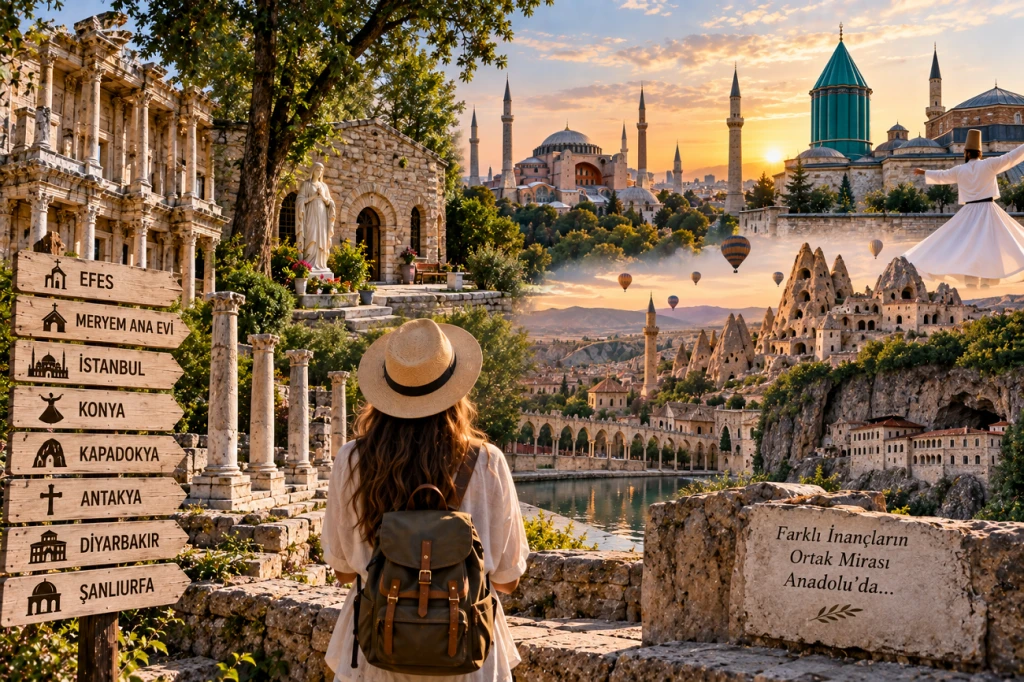
Top Destinations for Faith Tourism in Turkey
Throughout its thousands of years of history, Turkey has been a unique geography that has hosted various civilizations, religions, and beliefs. Mosques, churches, monasteries, synagogues, tombs, ancient cities, and sacred sites located in different regions of Anatolia make Turkey one of the important destinations for faith tourism.
Faith tourism is not limited to visits made solely for religious purposes. This type of travel, intertwined with history, culture, architecture, archaeology, and traditions, offers a comprehensive experience for travelers who wish to explore different periods of Turkey.
So, what are the most important destinations for faith tourism in Turkey? Here are the faith and cultural routes that must be considered.
What is Faith Tourism?
Faith tourism is a type of tourism that involves people visiting places considered sacred according to their religious beliefs, places of worship, tombs, churches, monasteries, and historically significant centers from a religious perspective.
In Turkey, faith tourism offers the opportunity to see traces of different religious and cultural heritages together, including Islam, Christianity, and Judaism.
Therefore, when creating a faith tourism route in Turkey, not only a single structure but also historical and cultural points in the same region can be included in the program.
Top 15 Destinations for Faith Tourism in Turkey
1. Şanlıurfa – The City of Prophets
Şanlıurfa is one of the most important destinations that come to mind when faith tourism is mentioned in Turkey.
The city has been a center for various beliefs in different periods and currently hosts numerous religious and historical structures. Among the most important points of Şanlıurfa for faith tourism is Balıklıgöl (Fish Lake).
Around Balıklıgöl;
- Halil-ür Rahman Mosque
- Rızvaniye Mosque
- Ayn Zeliha Lake
- Mevlid-i Halil Mosque and Cave
- Places associated with Hz. Ibrahim (Abraham)
can be visited.
Şanlıurfa can also be combined with trips to historically significant centers such as Harran, Soğmatar, and Göbeklitepe. GoTürkiye also defines Şanlıurfa as an important center where different beliefs have met throughout history.
Ideal for faith tourism: 2-3 days
2. Hatay – A Meeting Point for Different Beliefs
Hatay is one of Turkey's most important faith tourism centers with its historical structure where different religions and cultures live together.
One of the city's most important religious structures is Saint Pierre Church. Considered significant in Christian history, this structure highlights Antakya on faith tourism routes.
Additionally in Hatay:
- Habib-i Neccar Mosque
- Saint Pierre Church
- St. Simon Monastery
- Ulu Cami (Grand Mosque)
- Sheikh Ahmet Kuseyri Mosque and Tomb
are among the important points.
According to sources from the Hatay Governorate and GoTürkiye, Antakya is noted as an important faith tourism center hosting mosques, churches, and different religious heritages together.
Ideal for faith tourism: 2-3 days
3. İzmir – Ephesus and the House of the Virgin Mary
İzmir is one of Turkey's most important faith tourism destinations, especially regarding Christian history.
Ephesus Ancient City, located in the Selçuk district of İzmir, holds great importance not only for its archaeological value but also for early Christian history.
Main points to visit around Ephesus:
- Ephesus Ancient City
- House of the Virgin Mary
- Meryem Ana Church
- St. John Basilica
- Ayasuluk Hill
- Temple of Artemis
Ephesus is on the UNESCO World Heritage List and offers significant Christian heritage along with the House of the Virgin Mary.
For those wishing to engage in faith tourism + cultural tourism + archaeology tourism, Ephesus is a very strong route option.
Ideal for faith tourism: 1-2 days
4. Istanbul – A Historical Route with Mosques, Churches, and Synagogues
Due to hosting various empires and beliefs over centuries, Istanbul is one of Turkey's most comprehensive culture and faith tourism destinations.
In the city, it is possible to see religious structures from different periods within the same trip.
Among the prominent structures:
- Hagia Sophia
- Sultanahmet Mosque
- Süleymaniye Mosque
- Kariye
- Fener Greek Orthodox Patriarchate
- Aya Yorgi Church
- Neve Şalom Synagogue
- Zeyrek Mosque
are located.
A faith tourism program prepared in Istanbul can be combined with cultural routes around the historic peninsula and the Golden Horn.
Ideal for faith tourism: 2-4 days
5. Cappadocia – Christian History and Rock Churches
When Cappadocia is mentioned, fairy chimneys and balloon tours usually come to mind, but the region is also one of the important centers of Anatolian Christian history.
Especially the rock churches, monasteries, and underground cities around Göreme reveal the region's religious past.
In Cappadocia:
- Göreme Open Air Museum
- Tokalı Church
- El Nazar Church
- St. Barbara Chapel
- Kaymaklı Underground City
- Derinkuyu Underground City
can be visited.
One of Cappadocia's greatest advantages is its ability to combine faith tourism with nature, history, and cultural tourism.
Ideal for faith tourism: 2-4 days
6. Mardin – One of the Important Centers of Syriac Culture
Mardin is one of the important faith tourism destinations of Southeastern Anatolia with its stone architecture, historical monasteries, and structures carrying traces of different cultures.
Particularly structures belonging to the Syriac heritage stand out in the city surroundings.
Prominent points:
- Deyrulzafaran Monastery
- Kasımiye Madrasa
- Zinciriye Madrasa
- Mor Gabriel Monastery
- Mardin Grand Mosque
- Kırklar Church
Mardin can be evaluated not only for faith tourism but also for gastronomy and cultural tourism.
Ideal for faith tourism: 2-3 days
7. Diyarbakır – Historical Traces of Different Beliefs
Diyarbakır is an important cultural center that has hosted many civilizations throughout history.
In the city, traces of historical structures belonging to Islam, Christianity, and different cultures can be found.
Among the prominent structures:
- Grand Mosque
- Surp Giragos Armenian Church
- Meryem Ana Church
- Nebi Mosque
- Four-Legged Minaret
- Historical walls
are present.
When evaluated together with Mardin and Şanlıurfa, a comprehensive Southeastern Anatolia faith tourism route can be created.
Ideal for faith tourism: 1-2 days
8. Konya – Mevlana and Sufi Culture
Konya is one of the cities that stands out when Islamic culture and Sufi tourism are mentioned in Turkey.
The most important symbol of the city is Mevlana Celaleddin Rumi and the Mevlana Museum.
During a visit to Konya:
- Mevlana Museum
- Selimiye Mosque
- Şems-i Tebrizi Tomb
- Şems-i Tebrizi Mosque
- Karatay Madrasa
- Ince Minareli Madrasa
such historical and religious structures can be seen.
Especially during the Shab-e Arus period in Konya, it is one of the destinations receiving intense interest in terms of faith and cultural tourism.
Ideal for faith tourism: 1-2 days
9. Bursa – Ottoman and Islamic Heritage
Bursa is one of the cities that can be evaluated for faith tourism with its important religious and architectural works reaching from the early periods of Ottoman history to the present day.
In the city:
- Grand Mosque
- Green Mosque
- Green Tomb
- Emir Sultan Mosque and Tomb
- Muradiye Complex
- Tombs of Osman Gazi and Orhan Gazi
are among the important structures.
Walking routes covering the historic center of Bursa are ideal for visitors who want to discover religious structures and Ottoman architecture together.
Ideal for faith tourism: 1-2 days
10. Iznik – An Important Center of Early Christian History
The Iznik district of Bursa is an important destination regarding early Christian history.
Iznik stands out in Christian history especially with the Council of Nicaea.
In the city:
- Hagia Sophia Orhan Mosque
- Iznik Walls
- Roman Theater
- Süleyman Paşa Madrasa
- Historical church ruins
can be seen.
Iznik can be combined with Istanbul and Bursa to transform into a culture and faith tourism route.
Ideal for faith tourism: 1 day
11. Antalya and Demre – Following the Footsteps of St. Nicholas
The Demre district of Antalya is one of the important centers regarding Christian history.
The St. Nicholas Church there attracts attention in terms of faith tourism due to its historical heritage associated with St. Nicholas.
Demre can also be visited together with Myra Ancient City, which carries traces of the Lycian civilization.
Therefore, in Demre:
Faith + History + Archaeology
a travel program can be created.
Ideal for faith tourism: 1-2 days
12. Tarsus – The City of St. Paul
The Tarsus district of Mersin is another important destination regarding Christian history.
Tarsus is located on Christian pilgrimage and faith tourism routes due to the traditional belief that it is the birthplace of St. Paul.
In the city:
- St. Paul's Well
- St. Paul Church
- Grand Mosque
- Tarsus Historic Center
- Gate of Cleopatra
can be visited.
Tarsus can be planned together with historical routes around Mersin and Adana.
Ideal for faith tourism: 1 day
13. Akdamar Island – Van
Akdamar Island in Lake Van is an important destination regarding Christian heritage with the historical Akdamar Church.
The stone craftsmanship and reliefs on the exterior facade of the church are among the striking examples of the region's medieval architectural heritage.
A visit to Akdamar Island can be planned together with the Van city center, Van Fortress, and natural beauties in the surrounding area.
Ideal for faith tourism: 1-2 days
14. Trabzon – Sumela Monastery
Trabzon is one of the most important faith and cultural tourism centers of the Black Sea region.
Sumela Monastery, located in the Maçka district of the city, is one of Turkey's most striking religious structures with its impressive location built on steep cliffs.
Additionally in Trabzon:
- Sumela Monastery
- Hagia Sophia Mosque
- Atatürk Mansion
- Historic Ortahisar
- Boztepe
can be visited.
Sumela Monastery creates a very impressive route especially when combined with nature and cultural tourism.
Ideal for faith tourism: 2 days
15. Ephesus – Smyrna – Pergamon: The Seven Churches Route
One of the most special Christian history routes in Turkey is the route encompassing the Seven Churches mentioned in the Book of Revelation in the Bible.
These centers are:
- Ephesus – Selçuk
- Smyrna – İzmir
- Pergamon – Bergama
- Thyatira – Akhisar
- Sardis – Sart/Salihli
- Philadelphia – Alaşehir
- Laodikeia – Denizli
listed in order.
This route does not carry only a purpose of religious visit. It is also a cultural tour of significant importance regarding ancient cities, archaeological areas, and early Christian history.
Especially evaluating centers like Ephesus, İzmir, Bergama, Sardes, and Laodikeia in the same trip makes it possible to create a comprehensive faith and cultural tour.
How to Plan the Best Route for Faith Tourism?
When planning a faith tourism trip, besides the religious significance of the structures to be visited, transportation distances, accommodation points, and visit durations should also be taken into account.
For example, the Şanlıurfa–Mardin–Diyarbakır route can form a strong faith and cultural tour in Southeastern Anatolia.
In Western Anatolia, however:
İzmir → Bergama → Akhisar → Sardes → Alaşehir → Denizli → Ephesus
a route can be planned in this manner.
In the Black Sea region, however:
Trabzon → Sumela Monastery → surrounding historical and natural areas
a shorter program can be prepared.
Which Period is Most Suitable for Faith Tourism?
Faith tourism in Turkey can be done throughout the year. However, in routes where open-air archaeological areas are concentrated, spring and autumn months may provide a more comfortable travel experience.
Especially:
- April-May
- September-October
periods may be advantageous for walking and visiting historical areas.
In summer months, when temperatures are high in Southeastern Anatolia and Aegean routes, planning visits in the early morning hours may be more comfortable.
During the winter season, travel programs can be created based on special religious and cultural events in cities like Konya.
What Should Be Considered When Planning a Faith Tourism Tour?
When planning a trip for faith tourism, it is beneficial to pay attention to the following points:
- Check the prayer times of the religious structures to be visited.
- Learn about dress code rules in advance.
- Prefer comfortable walking shoes for historical areas.
- Carry water, hats, and sunscreen during summer months.
- Plan your accommodation well in advance during peak visit periods.
- Take transportation times into account for routes involving multiple cities.
- You can learn more about the region's religious and historical background in guided tours.
- Check museum and ruin site entry conditions before traveling.
Combine Faith Tourism with Cultural Tourism
One of Turkey's greatest advantages is that faith tourism can be easily combined with culture and history tourism.
For example, you can combine the Ephesus tour with the House of the Virgin Mary, the Şanlıurfa visit with Harran and Göbeklitepe, the Mardin tour with monastery and historic city routes, and the Trabzon trip with Sumela Monastery and Black Sea nature.
In this way, instead of just visiting religious centers, you can also discover the destination's history, architecture, cuisine, and cultural life.
Top Destinations for Faith Tourism in Turkey: Conclusion
Turkey is a country extremely rich in terms of faith tourism with its mosques, churches, monasteries, synagogues, tombs, ancient cities, and sacred sites.
From Şanlıurfa's identity as the city of prophets to Hatay's history bringing together different beliefs, from Ephesus's Christian heritage to Konya's Mevlana culture, from Mardin's monasteries to Sumela Monastery in Trabzon, there are many different travel options.
Especially the Seven Churches Route, the Şanlıurfa–Mardin–Diyarbakır route, and Christian history routes like Ephesus–Demre–Tarsus are notable options for faith tourism.
Plan Your Trip for Faith Tourism Now
Instead of creating your own faith tourism route, you can enjoy a more comfortable travel experience by planning transportation, accommodation, guidance, and the tour program all together.
Determine your vacation or faith tour dates → Choose your route → Plan transportation and hotels → Create a tour program suitable for you → Complete your reservation.
Do not delay your trip to discover Turkey's historical and spiritual heritage. Create a faith tourism route suitable for you and explore Anatolia's thousands of years of history on-site.