


The Seven Churches Route in Turkey
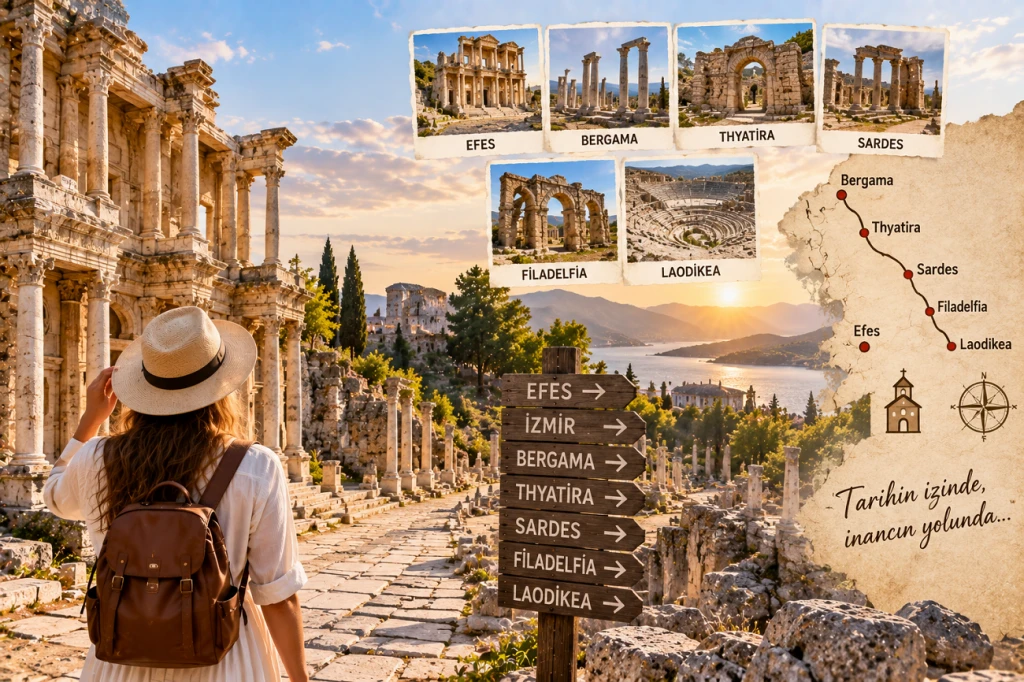
Seven Churches Route in Turkey: 7 Historic Cities Following the Trail of Revelation
Turkey is one of the most significant geographies in the world regarding Christian history. Especially Western Anatolia offers a very special route for faith tourism, history, and cultural tours due to the Seven Churches mentioned in the Book of Revelation of the Bible.
All seven of these early Christian communities, known as Ephesus, Smyrna, Pergamon, Thyatira, Sardes, Philadelphia, and Laodicea, are located today in the Aegean Region of Turkey. Therefore, the Seven Churches Tour in Turkey offers the opportunity to explore ancient cities, early Christian history, Roman and Byzantine heritage, and the cultural richness of Western Anatolia in a single journey.
Moreover, this route does not appeal only to those traveling for religious purposes. It offers a very rich experience for travelers interested in history, archaeology, culture, architecture, and ancient cities.
So, where are the Seven Churches in Turkey? How is the Seven Churches route done? How many days are needed? Which historical sites should be visited?
Here is a comprehensive travel guide for the Seven Churches Route, one of Turkey's most special faith and culture routes.
What are the Seven Churches?
The Seven Churches refer to seven early Christian communities to whom messages were sent by Apostle John in the Book of Revelation of the New Testament.
An important detail here is that the term "Seven Churches" does not refer to seven separate church buildings visible today. What is meant are the early Christian communities living in ancient cities. In some of these cities today, church ruins and structures from the early Christian period can be seen.
The seven centers mentioned in the Book of Revelation are:
- Ephesus – Ephesus
- Smyrna – Izmir
- Pergamon – Bergama
- Thyatira – Akhisar
- Sardes – Sart
- Philadelphia – Alaşehir
- Laodicea – Denizli
All seven of these centers are located in Western Turkey, in the Aegean Region.
1. Ephesus | Selçuk, Izmir
One of the most important stops on the Seven Churches Route is the Ancient City of Ephesus.
Ephesus, one of the important cities of the Roman period, is visited today as one of Turkey's most impressive archaeological sites.
Here you can explore not only the history of the Seven Churches but also daily life in the ancient world.
Places to see in Ephesus
- Celsus Library
- Great Theater
- Marmara Street (Marble Street)
- Temple of Hadrian
- Houses on the Hill
- Church of Mary
- Basilica of St. John
- House of the Virgin Mary
Ephesus is also one of the important historical areas within the UNESCO World Heritage list. Since it is one of the most comprehensive stops of the Seven Churches route in terms of cultural tourism, it may be beneficial to spend more than a few hours here.
Recommended duration: Half day–1 day
2. Smyrna – Izmir
The second stop of the Seven Churches is Smyrna, located in the center of modern-day Izmir.
Since the ruins of ancient Smyrna are within modern Izmir, it offers a different experience compared to other stops.
Places to see in Izmir
- Smyrna Agora
- Kadifekale (Castle of Velvet)
- Kemeraltı Bazaar
- Church of St. Polycarp
- Surroundings of Izmir historic center
Smyrna was one of the important and wealthy cities of the region in antiquity. Today, one of the most important ruins of the ancient city is the Agora.
Why is it important on the Seven Churches Route?
Smyrna is the second community mentioned in the Book of Revelation, and traces of ancient Smyrna can be seen under and around the historical fabric of modern Izmir.
Recommended duration: Half day
3. Pergamon – Bergama, Izmir
Pergamon, known today as Bergama, is one of the most impressive ancient cities on the Seven Churches Route.
The city offers visitors a panoramic view of an ancient city from a high point with its Acropolis, theater, temples, and historical ruins.
Places to see in Bergama
- Bergama Acropolis
- Ancient Theater
- Temple of Trajan
- Temple of Athena
- Asklepion
- Red Courtyard (Kızıl Avlu)
Pergamon is one of the important cultural areas listed on the UNESCO World Heritage List.
Importance regarding the Seven Churches
The early Christian community in Pergamon is the third community to whom a message was sent in the Book of Revelation.
Recommended duration: 1 day
4. Thyatira – Akhisar, Manisa
The fourth stop of the Seven Churches is Thyatira, located within the borders of the Akhisar district of Manisa today.
In antiquity, Thyatira was particularly known for trade, weaving, and bronze working. Today, it is an ancient settlement whose traces can be followed inside and around modern Akhisar.
Things to see in Akhisar
- Thyatira ruins
- Grand Mosque
- Historic city center
- Archaeological remains in the region
The difference of Thyatira from some other Seven Churches stops is that a significant part of the ancient city lies beneath the modern settlement.
Recommended duration: 2–3 hours
5. Sardes – Sart, Salihli, Manisa
Sardes is a historically very important stop on the Seven Churches route because it was the capital of the Lydian Kingdom.
In the ancient city, it is possible to see traces from the Lydian, Roman, Hellenistic, and early Christian periods together.
Places to see in Sardes
- Gymnasium
- Synagogue
- Temple of Artemis
- Ruins of Byzantine-era churches
- Ruins of the ancient city
Sardes was an important trade and cultural center in antiquity. Today, visitors can see both Lydian history and traces of the early Christian period in the same area.
Recommended duration: 2–3 hours
6. Philadelphia – Alaşehir, Manisa
The ancient Philadelphia, known today as Alaşehir, is the sixth stop of the Seven Churches.
The city was an important settlement center during the Roman period.
Although only a limited number of structures and ruins remain from ancient Philadelphia today, its symbolic importance for the Seven Churches Route is quite great.
Things to see in Alaşehir
- Ruins of the ancient city of Philadelphia
- Ruins of St. Jean Church
- Ancient city walls
- Historic city center
According to GoTürkiye, Philadelphia and Smyrna stand out as the two communities that did not receive negative criticism in the messages of the Book of Revelation.
Recommended duration: 2–3 hours
7. Laodicea – Denizli
The final stop of the Seven Churches Route is the Laodicea Ancient City.
Located north of Denizli, Laodicea stands out with its vast archaeological area and important structures from the early Christian period.
Places to see in Laodicea
- Laodicea Church
- Ancient Theater
- Stadium
- Agora
- Columned streets
- Ancient water structures
- Basilicas
Laodicea is considered one of the important centers regarding early Christian history. Archaeological excavations and restoration works continue today.
After Laodicea
After completing the Seven Churches tour, Pamukkale and Hierapolis can definitely be added to the program.
Recommended duration: Half day
How Many Days Does the Seven Churches Tour Take?
The ideal duration for the Seven Churches Route can be planned as 4–5 days.
A condensed program can be prepared for those who want to do it in a shorter time. However, if you want to spend enough time at each ancient city and explore the cultural values of the region, going beyond 4 days will be more comfortable.
In a more comprehensive Turkey faith tour plan, different destinations such as Kuşadası, House of the Virgin Mary, Pamukkale, Hierapolis, Antalya, or Istanbul can also be added to the route.
Best Time for the Seven Churches Tour
Since a significant part of the Seven Churches Route consists of open-air archaeological sites, weather conditions directly affect travel comfort.
Spring
The months of April–May can be quite pleasant for ancient city tours.
Summer
In June, July, and August, temperatures can be high, especially in open areas like Sardes, Laodicea, and Ephesus.
Therefore, visiting ancient cities early in the morning may be more comfortable.
Autumn
The September–October period is suitable for cultural tours due to milder air temperatures.
Winter
It can be considered for those seeking a quieter trip. However, the program should be kept flexible depending on rain and weather conditions.
Are Only Churches Visited on the Seven Churches Route?
No.
One of the most important features of this route is that it combines faith tourism with culture and history tourism.
Along the Seven Churches Route:
- Ancient cities
- Roman structures
- Hellenistic period artifacts
- Lydian heritage
- Early Christian ruins
- Byzantine structures
- Museums
- Historic city centers
can be seen.
For example, stops like Bergama, Sardes, and Ephesus are of great importance not only in terms of religious history but also in understanding the multi-layered history of Anatolia.
Which Places Can Be Added to the Seven Churches Route?
Important destinations in the nearby vicinity can be added to the program for those who want to make the route more comprehensive.
Izmir
- Ephesus
- House of the Virgin Mary
- Smyrna
- Bergama
Aydın
- Kuşadası
- Miletus
- Didyma
Manisa
- Sardes
- Alaşehir
- Akhisar
Denizli
- Laodicea
- Hierapolis
- Pamukkale
In this way, instead of just visiting the Seven Churches, you can create an Aegean Region culture tour.
Who Is the Seven Churches Tour Suitable For?
This route is particularly suitable for the following travel groups:
✝️ Those interested in faith tourism
Those who want to see important centers of Christian history in person.
🏛️ History enthusiasts
Those who want to explore the Roman, Hellenistic, Lydian, and Byzantine periods.
📸 Photography lovers
Ancient cities, columns, theaters, and historical structures offer very rich content for photography.
🎓 Those wanting to take a cultural tour
Those who want to explore the multi-layered history of Western Anatolia in Turkey.
🌍 Foreign tourists
Visitors who want to include faith tourism and culture tours in their Turkey trip.
What Should Be Taken for the Seven Churches Tour?
Since the program will be walking-heavy in ancient cities, it would be beneficial to have the following items in your travel bag:
- Comfortable walking shoes
- Hat
- Sunglasses
- Sunscreen
- Water
- Small backpack
- Clothes suitable for the season
- Camera or phone
- Charger/power bank
- Personal medications
Especially in summer months, it should not be forgotten that long walks will be taken in open-air archaeological sites.
Map of the Seven Churches Route
You can think of the route generally as follows:
IZMIR
↓
Smyrna – Izmir
↓
Pergamon – Bergama
↓
Thyatira – Akhisar
↓
Sardes – Sart / Salihli
↓
Philadelphia – Alaşehir
↓
Laodicea – Denizli
↓
Ephesus – Selçuk
↓
IZMIR
This itinerary offers the opportunity to explore one of the most historically and culturally rich regions of Western Anatolia.
Best Accommodation Points for the Seven Churches Route
If you spread the route over 4–5 days, planning accommodation in several different cities may be more comfortable.
Izmir
For the start of Smyrna and Bergama.
Bergama
For accommodation after visiting Pergamon.
Salihli / Alaşehir
For Sardes and Philadelphia stops.
Pamukkale / Denizli
For Laodicea, Hierapolis, and Pamukkale.
Selçuk / Kuşadası
For Ephesus and the House of the Virgin Mary.
Especially for foreign visitors, a route with entry and exit via Izmir Airport can be a practical option in terms of transportation.
Why Is the Seven Churches Route Special?
The most important feature that distinguishes the Seven Churches Route in Turkey from other culture tours is that you can follow the traces of different civilizations and the history of faith in a single journey.
You might visit Ephesus, one of the most important cities of the Roman period, one day, and the next day explore Sardes, the capital of Lydia; then you can reach Laodicea, an important center of early Christian history.
Moreover, along the route, you can include different tourism points such as Pamukkale, the House of the Virgin Mary, Bergama, Izmir, and the historic cities of the Aegean in your program.
Therefore, the Seven Churches Tour is a very strong travel product in terms of faith tourism + culture tourism + history tourism.
Plan Your Reservation for the Seven Churches Tour in Turkey Now
The Seven Churches Route stretching from Ephesus to Smyrna, from Bergama to Sardes, and from Philadelphia to Laodicea offers a unique experience for those who want to discover thousands of years of history in Western Anatolia.
Whether you plan an individual trip or carry out the Seven Churches Tour as a group; with proper transportation, accommodation, and professional guidance, you can explore the route much more efficiently.
Don't Delay Your Seven Churches Journey!
Determine your travel date → Create your Seven Churches route → Plan your transportation and hotel options → Choose your professional guide and tour program → Complete your reservation.
Plan your Seven Churches journey now to discover the history of Western Anatolia and the Christian heritage in person!